
Crypto assets, including Bitcoin, sank Monday as markets continued to worry about worsening macroeconomic conditions that may put an end to these assets’ two-year long bull run.
Leading cryptocurrency Bitcoin (BTC) was down nearly 7% to trade at circa $46,500 around 1608 New York time. Meanwhile, Ether (ETH), the second-best crypto, plunged by almost 9.50% to $3,740. Other “altcoins” posted more losses, with Ether’s emerging competitor in the blockchain space, Solana (SOL), plunging over 12.50% to around $150 per token, and Cardano (ADA), sinking by 10.50% to approximately $1.20.

On the whole, the cryptocurrency market lost nearly $250 billion so far this Monday, awaiting further losses ahead of the Federal Reserve’s two-day policy meeting beginning this Tuesday.
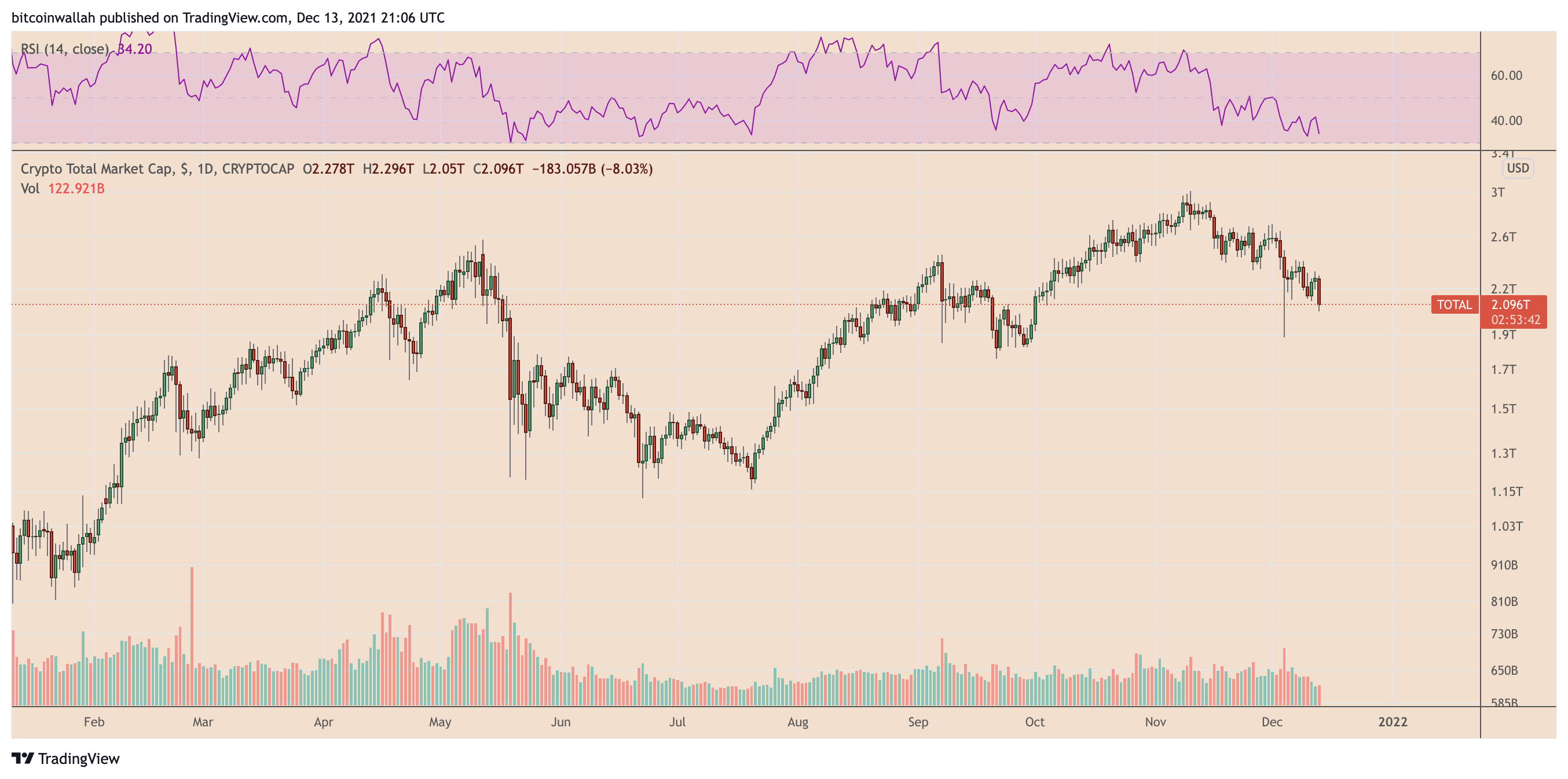
The FOMC FUD is Here for Bitcoin
The Federal Reserve will release its decision on how aggressively it plans to combat the persistently rising inflation.
Many economists anticipate that the U.S. central bank would move quickly to unwind its $120 billion a month asset purchasing program now that the labor market has recovered and threats of Covid-19 lockdown have subsided due to faster vaccinations. Meanwhile, they expect the Fed to increase its interest rates from the current near-zero levels right after tapering.
After last week’s consumer price index (CPI) report, Hopes are high. It showed that inflation in the U.S. increased in November at its fastest pace since 1982. As a result, the pressure on the Fed to act is higher than ever since the start of the pandemic in March 2020.
Low rates and easy monetary policy have helped Bitcoin and other crypto-assets rallies across 2020 and 2021. However, removing that support may end up wiping a good portion of those gains, many analysts say.
“The Fed might break risk assets with some accelerated tapering,” wrote Nick from Ecoinometrics Monday, adding that:
“The Bitcoin on-chain accumulation trend has been stalling this week so the price support is weak.”
Meanwhile, on-chain analyst Dylan LeClair noted that tapering would boost the appetite for the U.S. dollar among investors, thus creating further negative pressures for risky assets like Bitcoin.
8. Things to watch out for is tightening financial conditions heading into 2022:
The $DXY specifically, which measures dollar strength against a basket of fiats has been steadily rising throughout 2021.
Rising $DXY = Tightening financial conditions = Risk assets perform poorly pic.twitter.com/1KTMNgR8hz
— Dylan LeClair 🟠 (@DylanLeClair_) December 11, 2021
If Bitcoin falls, it risks taking the entire crypto market with it, as happened during the previous bear phases in early 2020, 2019, and 2018.