
The AUD/USD currency pair has been under much pressure since it returned to about 0.6660 at the start of the European session. The US Dollar Index’s rise has made Aussie offers more attractive (DXY). The Australian dollar may stay active until Wednesday, when the monthly Consumer Price Index (CPI) is released.

On Monday morning, S&P500 futures went up because investors thought small US banks would get more help earning cash. The 500-US stock futures basket has kept its bullish tilt from Friday, which shows that market participants are more willing to take risks.
The US Dollar Index (DXY) is holding on to the 103.00 support because of predictions that a strong preliminary S&P Global PMI could make it less likely that the Federal Reserve will stop raising interest rates (Fed). From 47.0 and 47.3, the manufacturing PMI went up to 49.3. The Services PMI went up from 50.5 and 50.6 to 53.8.
Also, demand for US government bonds has gone down, which has caused 10-year US Treasury rates to rise above 3.38 per cent. US two-year Treasury yields that track US stocks have increased above 3.38 per cent, which could pressure risk-sensitive assets.
This week, the monthly Retail Sales and Consumer Price Index (CPI) numbers will affect the Australian Dollar. Retail Sales (Feb) are expected to increase by 0.4% on Tuesday, down from 1.9% the day before. Since the Reserve Bank of Australia (RBA) is very worried about inflation, policymakers would be happy if retail demand went down.
At its April meeting, the Reserve Bank of Australia hinted at a pause in raising interest rates. This was because the CPI dropped sharply each month.
Trade Idea:
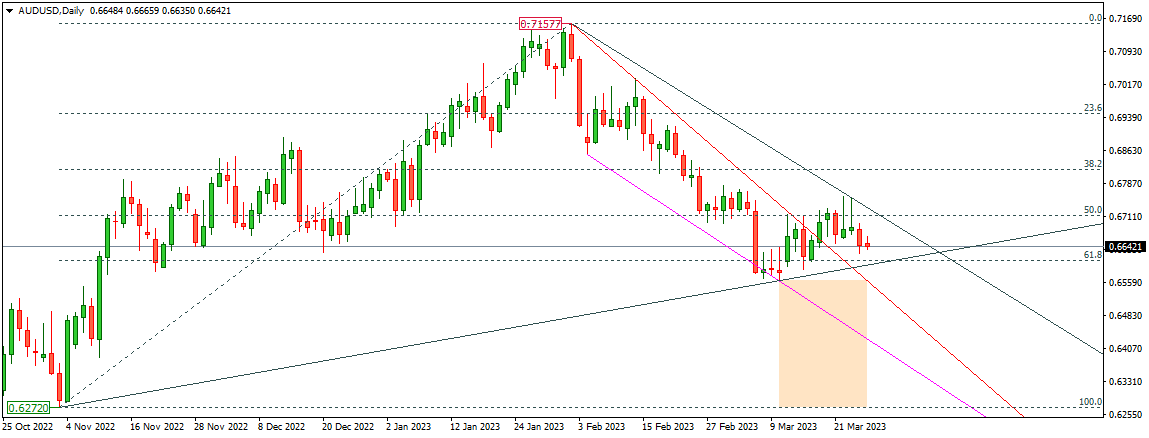
AUD/USD is moving in an Inverted Flag pattern, a bearish pattern that follows a downward move. Rates have already been raised to 3.60 per cent by Governor Philip Lowe.