
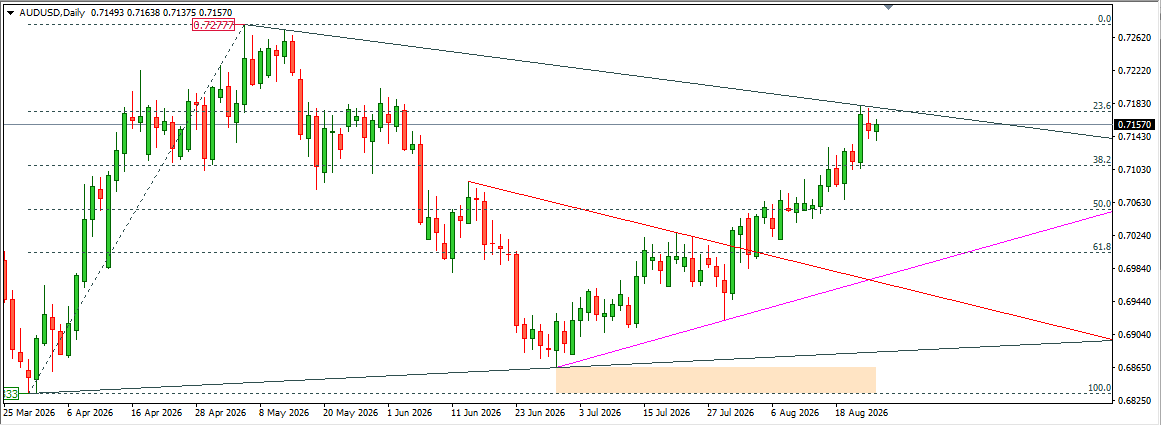
AUD/USD steadies around the mid-0.7100s on Tuesday, recovering most of the previous session’s losses as the Australian Dollar gains support from a hawkish reading of the Reserve Bank of Australia’s July meeting minutes. A softer US Dollar is also helping keep the pair supported.

The RBA minutes indicated that several policymakers believe another interest-rate increase could still be necessary, particularly as inflation risks remain tilted to the upside. Officials highlighted rising Oil prices, broader cost pressures and strong demand linked to the data-center investment boom as factors that could keep inflation elevated.
However, policymakers also acknowledged risks that could work in the opposite direction, suggesting that future decisions will remain highly dependent on incoming economic data. Market expectations have nevertheless strengthened, with futures now pricing slightly above a 60% probability of another RBA rate hike before the end of the year.
The next major catalyst for the Australian Dollar arrives on Wednesday with the release of Australia’s July Consumer Price Index. A stronger-than-expected inflation reading could reinforce expectations for additional RBA tightening and provide further upside momentum for AUD/USD. Conversely, softer inflation could reduce rate-hike expectations and weigh on the Aussie.
The US Dollar remains under pressure following the US Treasury’s decision to at least double its buyback operations for longer-dated government bonds. Reports that Treasury Secretary Scott Bessent could potentially use as much as $1 trillion from the Treasury General Account to finance the purchases have added to concerns surrounding US fiscal policy.
Meanwhile, escalating US sanctions against Iran are adding another layer of uncertainty to markets. For now, the combination of hawkish RBA expectations and Dollar weakness continues to provide a supportive backdrop for AUD/USD.
Trade idea:
AUD/USD remains bullish above 0.7100; buying dips toward 0.7120 could target 0.7200, while a break below 0.7080 would weaken the bullish outlook.