
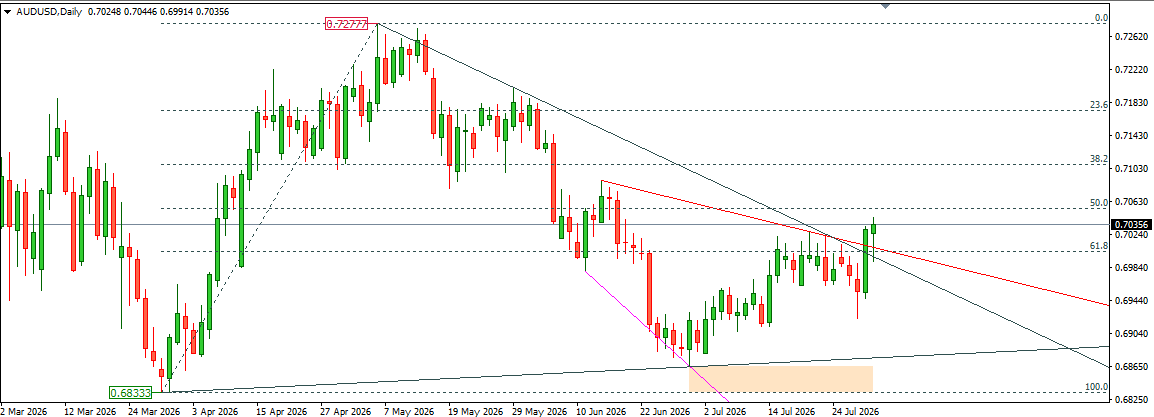
The AUD/USD pair traded around the 0.7020 level during Friday’s American session, remaining under modest selling pressure as weaker-than-expected economic data from China overshadowed stronger Australian inflation figures. At the same time, hawkish remarks from a Federal Reserve official boosted the US Dollar, limiting the Australian Dollar’s ability to recover.

China’s latest economic data highlighted a slowdown in business activity, raising fresh concerns about demand from Australia’s largest trading partner. According to the National Bureau of Statistics, the Manufacturing Purchasing Managers’ Index (PMI) declined to 49.2 in July from 50.3 in June, falling below market expectations of 50.0 and returning to contraction territory. The Non-Manufacturing PMI also weakened, dropping to 49.0 from 50.2, missing forecasts and signaling softer activity across the services sector.
The disappointing Chinese figures weighed heavily on the Australian Dollar, as Australia’s export-driven economy is closely tied to Chinese demand for commodities and raw materials. Slowing business conditions in China have therefore increased concerns about weaker external demand, reducing investor appetite for the Aussie.
On the domestic front, Australia released stronger inflation-related data that offered some support to the local currency. The Producer Price Index (PPI) rose 3.6% year-over-year in the second quarter, accelerating from 3.0% in the previous quarter. The increase suggests that cost pressures remain elevated at the producer level and could eventually filter through to consumer prices. However, the stronger inflation reading was not enough to counter the broader impact of China’s weak economic performance and renewed US Dollar strength.
The Greenback gained additional momentum after Dallas Federal Reserve President Lorie Logan delivered a hawkish assessment of the US economy. Logan argued that current monetary policy is not significantly restraining economic activity and warned that inflation remains above the Fed’s 2% target. She also stated that inflation risks continue to lean to the upside and indicated she would have supported a 25-basis-point interest rate hike, suggesting that modest tightening now could prevent the need for more aggressive action later.
With China’s economic outlook remaining uncertain and Federal Reserve officials maintaining a firm stance on inflation, the near-term bias for AUD/USD is likely to remain cautious despite resilient Australian inflation data.
Trade Idea:
Sell AUD/USD below 0.7015, targeting 0.6960, with a stop-loss at 0.7055. Weak Chinese economic data and hawkish Federal Reserve expectations may continue to pressure the Australian Dollar.