
Coinbase, a leading crypto exchange in the United States, is launching x402. According to Coinbase, x402 is an open-source protocol for payments that aims to redefine agentic commerce. In an X thread, the platform disclosed the details of the latest project.
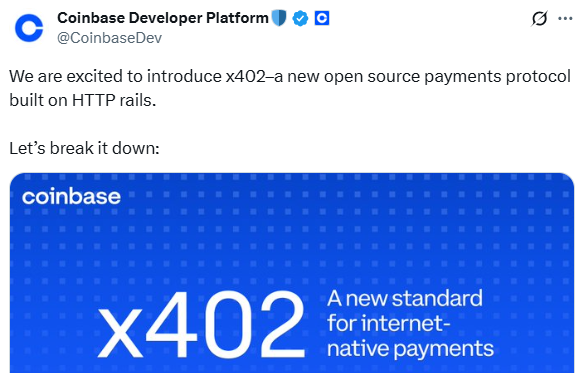
Coinbase Unveils x402 to Expedite Advancement in Agent-Led Commerce

x402 denotes Coinbase’s exclusive move to expand open-source payments. The protocol is developed on the basis of HTTP, particularly, the long-unused HTTP 402, which is a status code. Particularly, x402 turns it into a payment layer. With this development, anyone can request payments as well as pay for digital assets. The payment protocol focuses on delivering seamless on-chain payments. This development could lead to a new epoch of agent-led commerce along with unparalleled monetization to facilitate API providers, service platforms, and content creators.
HTTP 402 has reportedly existed in the form of the blueprint of the internet for decades without being used. The original purpose of HTTP 402 was to support online payments. Nonetheless, it was not utilized until now. At present, x402 permits Coinbase to bring that dormant feature to life, making 402 a robust payment layer. In this respect, the protocol allows for the payment requests and responses with diverse digital dollars like stablecoins, including $USDC.
Trending Now: Arizona Halts Bitcoin Reserve Plan as Governor Vetos Bill
A key transformative feature of x402 takes into account its capability to expedite the creation of completely independent AI agents. In this respect, it simplifies the experience, letting agents autonomously pay according to API calls. Hence, there is no requirement for subscription methods or even manual management of payments. Specifically, every request can be loaded with a unique on-chain signature for payment. This enables scalable and seamless access to services and tools.
Letting Agents Autonomous Spend, Interact, and Earn in Fully Compliant and Trustless Setting
As per Coinbase, x402 provides a notable opportunity for the wider community and developers to boost the on-chain commerce. The endeavor underscores the wider shift towards agent-led and programmable financial systems. Thus, the agents can spend, interact, and earn independently in a compliant and completely trustless manner.