
The GBP/USD currency pair tried to recoup some of the lost gains at the closing hours on Friday rising by 50 basis points from the day’s low of 1.3500 to about 1.3550 before pulling back again to end the trading session at about 1.3525. Overall, the pair closed 50 basis points from Thursday’s close of 1.3575, which marks a week that has been characterized by contradicting macro data from both the U.K. and the U.S.
The U.K. has made key macro-economic data over the last few weeks, most of which did not go well with investors. This continued to put pressure on the GBP, which peaked this year to trade at about 1.4375 against the USD.

The pair has this year traded well above 1.4260 on two occasions forming a double-top. The current decline following its recent peak, however, looks set to take the GBP/USD pair to new territories last touched in January, with traders showing little pragmatism on a potential rebound.
The decline since April 17 has been highlighted by major economic events, which on the side of the GBP disappointed investors, whereas, for the U.S., the data coming from the Federal Reserve has been remarkably promising.
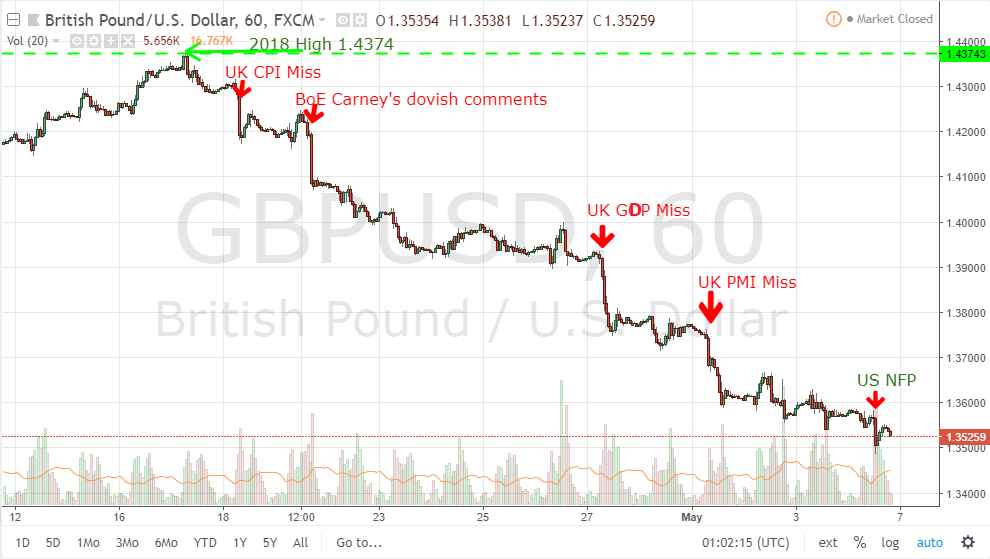
The first knock on the GBP came on April 18 after the U.K.’s CPI increased just 0.1% in March from February. Analysts had predicted an increment of 0.3%. The tepid growth rate was also massively dwarfed by the 0.4% increment reported in the previous month.
This was the first signal of what has since turned out to be a disappointing month for the Pound, and even going into next week and looking forward to the rest of month there is little to suggest that a major rebound could be coming soon.
The following day while delivering Bank of England’s statement on economic outlook, Carney’s dovish comments did not help the already wounded pound. It was more like rubbing salt to the injury, and this subsequently sent the GBP/USD currency pair nosediving to what has since been confirmed to be a bottomless pit of trader skepticism.
Then later in April, the GDP data was released again keeping up with the trend of disappointments. The 0.1% growth reported missed analyst estimate of 0.3 further damaging the strength of the GBP against major currencies.
Pressure on the GBP against the USD was compounded at the start of May, when Non-Farm Payrolls again demonstrated the strength of the U.S. economy amongst other developed countries. And while jobless claims did rise slightly, this was not enough to pin the Dollar down against the Pound.
So, what next for the GBP/USD pair ahead of the new week?
Looking forward, traders will be looking at key support levels (S1), at 1.3500, which could be breached again next week. The market has already shown some bit of resilience to try to hold the pair at this level, but not with great success. Therefore, some could already be looking at 1.3000 at (S2), as the next target, but we could also see some resistance once the GBP/USD pair hits 1.3300.
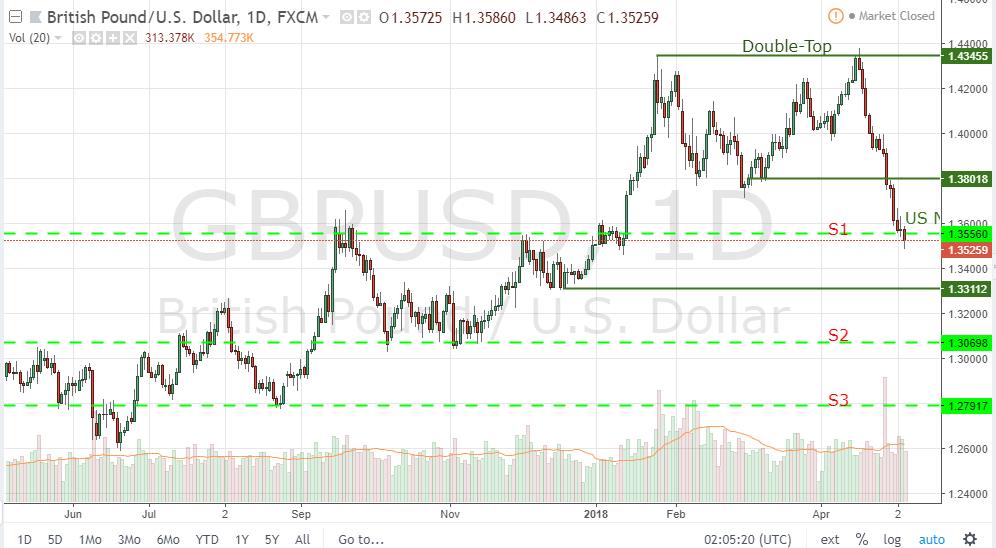
However, the pair has yet to bearishly break through the 1.3500 level this year. The last time it traded below this key support zone was in December last year. That’s also the last time it hit the 1.3300 mark. So, unless the market is willing to push the sell button further to the level of hitting a new YTD low, then it is not too unrealistic to start assessing some bullish targets.
And to get traders rolling on this, the immediate target comes at the most recent major support, which triggered the rebound that led to the formation of the double-top. That’s at about the 1.3800 mark, which makes it just about 275 basis points away. Other bullish long-term targets for traders that prefer to overlook the short-term market turbulence can be found at 1.4000, 1.4200 and 1.4400.
However, should the market defy technical views and heed the warnings coming out of both the U.K. and the U.S. macroeconomic departments, then sliding further south could see the pair breach the 1.3000 intermediate period and 1.2800 long-term.
In summary, the GBP/USD looks to be technically poised for a rebound in the coming week, but fundamental data suggests otherwise. So, whose warnings will the market heed?