
USDCHF appears to be staging a bullish recovery after finding strong support at the 0.80334 level, which represents the 0.0% Fibonacci retracement of the recent downtrend. The pair has been steadily climbing and is currently testing the 38.2% Fibonacci level at 0.81088.
The price action shows that USDCHF formed a falling wedge pattern between April 17-20, with a decisive breakout to the upside confirming bullish momentum. Since then, the pair has been making higher lows, suggesting buyers are gaining control of the market.

Looking at the Fibonacci retracement levels, the 38.2% Fib at 0.81088 is currently acting as immediate resistance, with the pair trading around 0.81292. If bulls maintain control, the next targets would be the 50% retracement level at 0.81321 and the more significant 61.8% Fib at 0.81553.
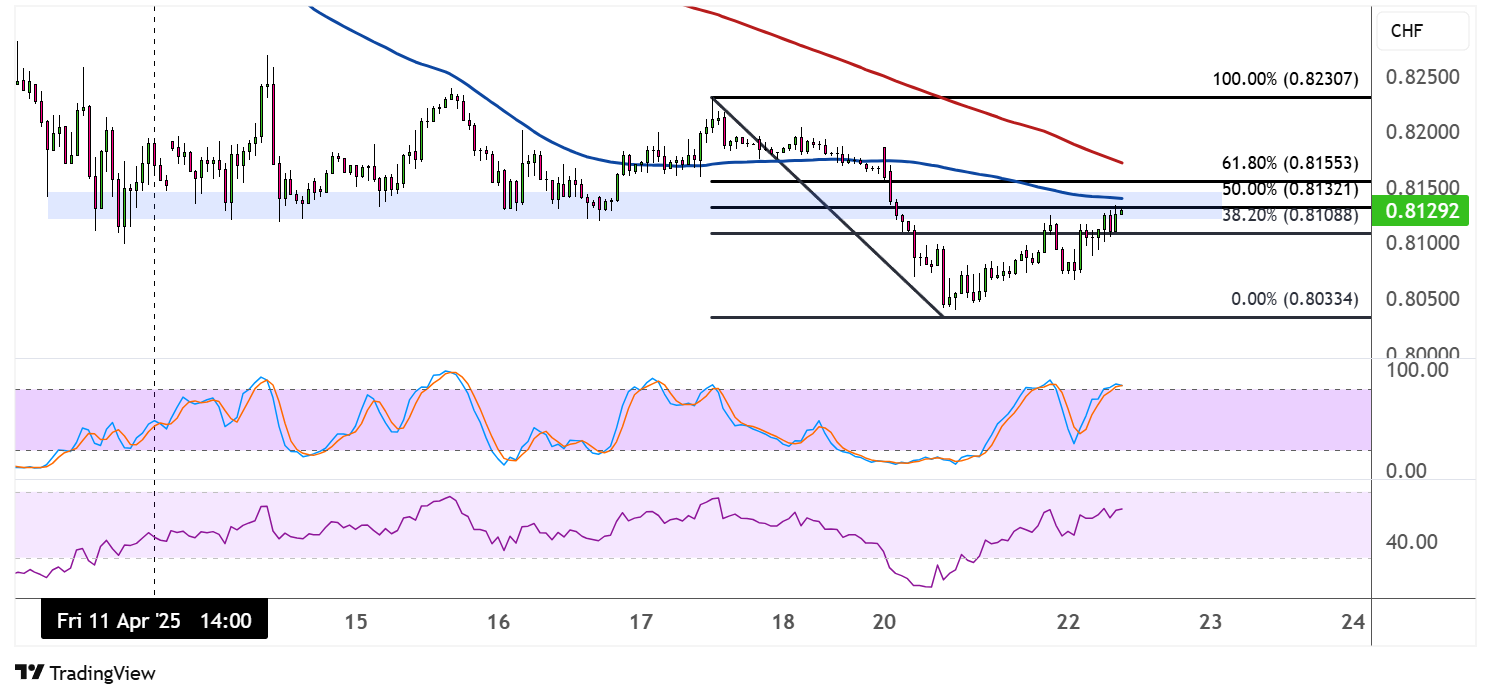
On the subject of moving averages, the blue 100 SMA is still above the current price, suggesting there could be some resistance ahead. However, the price has already crossed above the lower moving average, which might now serve as dynamic support on pullbacks.
The stochastic oscillator is showing strength as it moves higher in the upper region of its range, indicating strong buying momentum. However, traders should be cautious as it approaches overbought conditions, which could trigger a short-term pullback.
Meanwhile, the RSI (purple line) is steadily climbing from previously oversold levels and has now reached around 40, confirming the improving bullish sentiment without yet being overbought.
If the current momentum continues, USDCHF could challenge the 61.8% Fibonacci level at 0.81553, which coincides with previous support-turned-resistance. A break above this level could open the path toward the 100% Fibonacci mark at 0.82307.
On the downside, immediate support lies at the 38.2% Fib (0.81088), followed by the recent swing low near 0.80500. The pair may continue its sideways to bullish bias as long as price holds above the 0.80334 support level.
Trade headlines could continue to influence USD price action, along with the current selloff in USD-denominated holdings.