
A stop order is an order to buy or sell once a specific price has been reached. Stop orders can be used for trade entries and exits.
Entry Stops

An entry stop order is used to purchase a currency pair if the price has risen or fallen to particular price levels. Thus we speak of a Buy Stop, or a Sell Stop. Usually, a certain price level in the path of price advance or decline must be breached for a stop order to be triggered. Situations where these occur are as follows:
- An upward breakout of the price above a resistance. Usually the stop order price would be set above the resistance, so that the trigger is made in the line of price advance.
- A downside breakout of price below a support level. In this instance, the stop order is set below the support so that the order is triggered along the continued path of price decline.
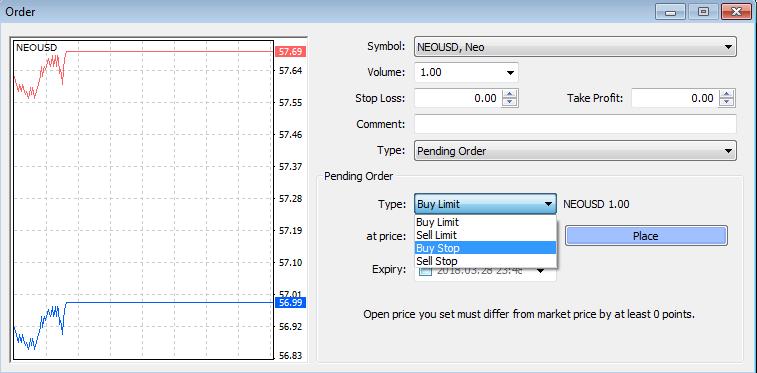
How to Apply an Entry Stop
Breakouts signal that a significant move in the direction of the break will occur. The trap for the trader is how to identify them. The first step is to identify the support or resistance correctly, after which the trader must identify what the price bar does that signals a breakout.
Chart patterns are bounded by lines that could constitute support or resistance. Look at triangle, wedges, or necklines in the head/shoulder pattern. These are support and resistance lines. The price bar must break through the support or resistance in focus, and close above (resistance break) or below (support break) those areas. If the price bar merely breaches these areas and does not close either above the resistance or below the support, a breakout has not occurred. Always confirm that the break has occurred when setting your entry stop.
Exit Stops
What is an exit stop? An exit stop is an order to exit the trade at a stop price and can be used in two ways:
- It can be used to protect gains that have already been acquired in a trade, but which have not yet been realized. The exit stop here is known as the Trailing Stop. It is set at some distance behind advancing prices (in a long trade), or declining prices (in a short trade). The stop here will chase the price action as it moves, but will hold steady when prices turn against the position. If prices keep turning against the trader’s position until the critical point is reached (that is, the price at which the trailing stop is located), the trade will be closed automatically, and any profits so protected will be banked by the trader.
- The exit stop can also be used to protect further loss of capital when the trade is in a losing position. In this manner, the stop is acting as a Protective Stop.
The use of exit stops is a necessity, either to protect capital initially, and then to protect profits if the trade has entered into profit territory.
There are rules that must be adhered to when setting entry and exit stops. For entry stops, establishing the breakout level as well as identifying the breakout itself is crucial in ensuring that a fakeout candle does not trigger the entry and recoil back to where it came from. In other words, the trader must confirm that a valid breakout is occurring and not a fakeout.
For exit stops, one is actually limiting risk; limiting risk of losing capital or that of losing profits. Just like entry stops, the trader must know how to set a good exit stop so as not to make them too loose and give up much to the market, or too tight and lose out on good profit.
The greatest risk with entry and exit stops is whipsaws. A whipsaw is a choppy price movement which has no defined direction. It only serves to trigger stops and open or close trades that do not benefit a trader. A bad whipsaw will trigger an entry stop only for price to move in the opposite direction, or trigger an exit stop and cause what may have turned out to be a good trade to be stopped out prematurely. There is nothing as heartbreaking in forex as seeing a whipsawed, stopped out trade eventually turning out right.
Exit stops could either be protective, or they could of the trailing variety.
Setting Protective Stops
A protective stop has to be determined before the trade entry. A consideration that must be made in this regard is the reward being sought for the risk being taken. If after analysis of where to properly place a protective stop is made, it is discovered that the profit being sought as reward will not be at least three times the protective stop distance (in pips), please do not take the trade.
Support and resistance levels are key considerations in the setting of a protective stop. For instance, a trader who wants to go long on an asset that has a defined trend line support, must consider placing the stop below the support level.

Likewise, a trader that wants to go short on a currency pair must consider setting the stop above a resistance trend line. The thinking is that even if price action wants to breach these areas, the support or resistance will firm against the price and cause the price not to reach the stop as to trigger it.
Setting Trailing Stops
Trailing or “progressive” stops are used to chase advancing prices that have already attained some profits. They are used to protect against sudden price reversals, which can occur at any time for a variety of reasons that are unforeseen by the trader.
One application is if downtrending price action breaks a support line in one move and keeps pushing downwards. Knowing that a broken support will become a resistance, a trader may decide to set a trailing stop above the market price, but between the broken support and the next one. If you use a pivot point calculator or a Fibonacci retracement tool, you can see this in action very clearly.
While this method is good, it relies too much on chance in placing the trailing stop. So another method which introduces certainty in placement of the trailing stop is introduced. You can use a trend line with a confirmation filter to provide a basis on which to set a trailing stop.
Other methods used in setting trailing stop include using:
- Intrinsic volatility (detected using the Average True Rang indicator)
- Percentage gain
- Parabolic SAR indicator.
Setting a Money Stop
The methods of setting exit stops described above are all “technical stops”; they rely on the use of tools of technical analysis. Some exponents prefer to ditch these technical stops and use what is known as the money stop. This assumes the position that a trader knows just how much money he or she is willing to lose in pursuing some gain.
When examined from a risk management standpoint, there is a lot of risk in not considering technically valid points of exit. So if a comparison was to be made between technical stops and money stops, technical stops will produce better money management results.
Is it OK to Change Stop Orders?
When it comes to protective stops, the principle of use is never to adjust the stop away from the prevailing trend. This goes against the practice of most retail traders, who usually move the protective stops further and further away from the entry price so as to “allow the trade to recover”. This usually leads to “letting losses run” as opposed to the principle of cutting losses.
Stops are built to protect capital. So the question is: what if the initial analysis was faulty? The answer is that the stop should be kept as it is in order to inculcate trading discipline and to keep the risk level stable, relative to reward. Do not forget that a good trade should aim for a reward that is at least 3 times the risk. Adjusting the stop will negate this and even bring the risk at par to the expected reward. This is wrong practice.
A reward-risk ratio of 3:1 means that a profitable trade will cancel out three bad ones. So you really should not start widening the stop so as to reduce this ratio to 2:1 or 1:1. This will pressurize your next set of trades and cause you to make mistakes. You must resist the emotional pressure of adjusting a protective stop and keep your risk level per trade at one-third of the reward.
The situation is different when it comes to trailing stops. With a trailing stop in place, there is no possibility of loss. The worst that can happen is that smaller than expected profits may be collected, but these are profits all the same. It is alright to adjust a trailing stop, but only in the direction of the price that it is trailing. It should never be moved against the trend as it will give up much profit to the market.
Conclusion
In conclusion, here are some takeaways when it comes to stops in forex.
Many traders place stops very close to the entry price. Many trades initially become negative before they head into positive territory for the long term. If you are trading off a daily chart, moves take a long time to resolve. A protective stop may have to be placed hundreds of pips away from the entry price, which will demand you have enough margin to run with as well as money management skills to work with. Putting a stop too close to then entry price will invariably get that trade stopped out too soon. Give your stops room to breathe as nobody has the foreknowledge of the maximum top or bottom of a trend that will enable precise stop placement.
In setting trailing stops, you should also watch for signs of fatigue of the trend. In this situation, it is warranted to set the trailing stop close to the market price so as not to give up too many pips to the market if a reversal starts to occur.