
- Bitcoin was trading modestly higher on Monday as rising tensions between the U.S. and China increased traders’ safe-haven appetite.
- The cryptocurrency surged 1.03 percent to $9,544 during the early morning New York trade.
- Risks of downside correction loom as price moves into strict resistance areas.
Bitcoin price edged up Monday amid expectations that escalating tensions between the U.S. and China would raise its safe-haven appeal.
The benchmark cryptocurrency was trading 1.03 percent higher at $9,544 minutes into the New York opening bell. Its gains appeared after a weekend of choppy trade, wherein price fluctuated within the range between $9,764 and $9,369, according to data fetched by Coinbase.

The seesaw price action showed traders’ inability to hold or break above local tops. That proved that bitcoin is trading in a bias-conflicted area. While a move towards $10,000 could yield sustainable profits, a plunge below $9,000 could also extend the move towards $8,000.
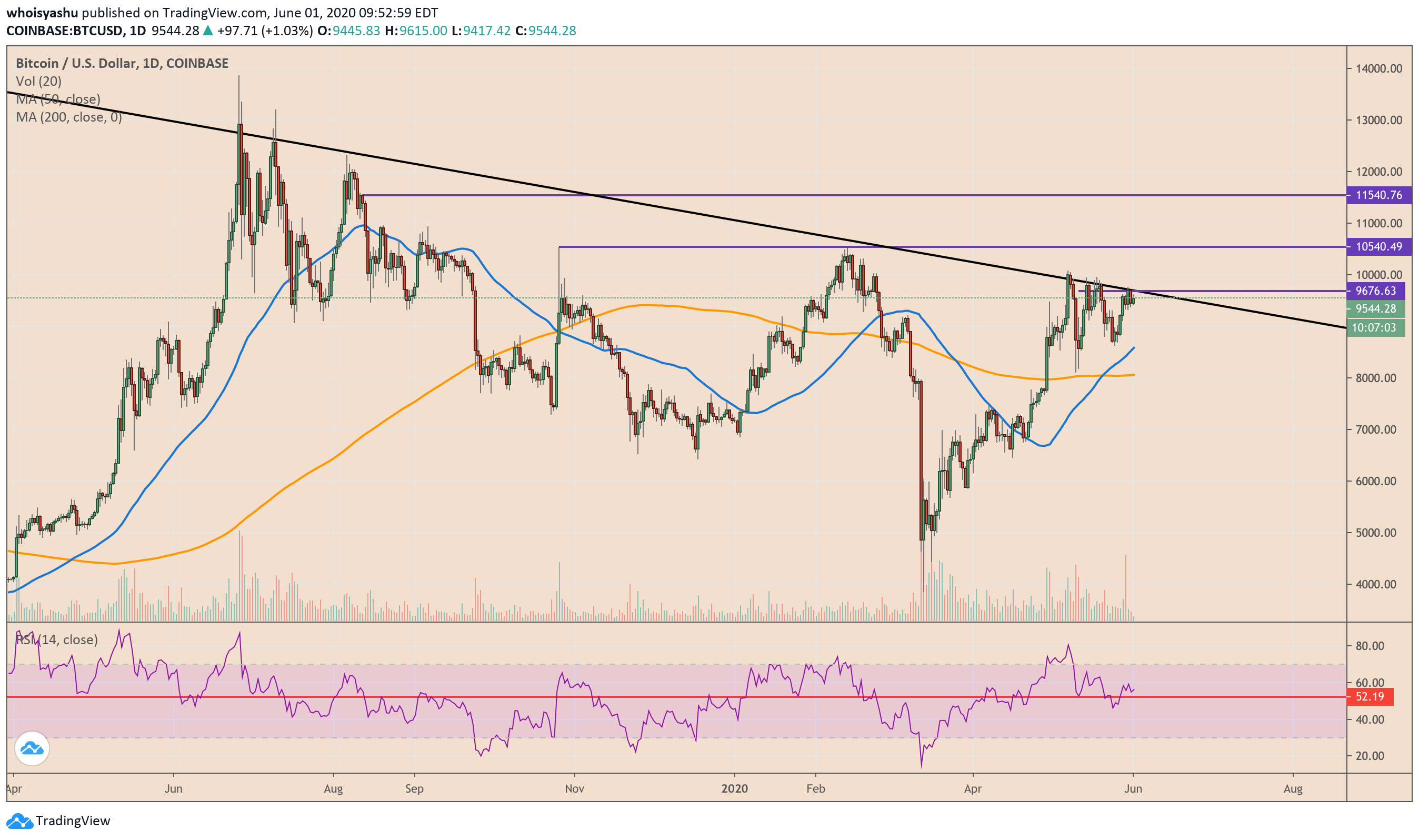
But psychologically, Bitcoin’s interim bias remained shifted towards bears. The cryptocurrency’s uptrend showed signs of weakness near a long-term descending trendline (blacked). The area typically increases Short sentiment, pointing to traders’ unwillingness to bear risks of opening bullish positions near local tops.
The downside sentiment could fire bitcoin back towards the $9,000-support level this week. Meanwhile, breaking above the blacked trendline could send prices higher towards $10,500.
Positive Fundamentals
It is vital to notice that Bitcoin is sustaining its gains above $9,500 at a time when the S&P 500 has opened lower. Concerns over recent civil disturbance, as well as China’s temporary halt on the imports of some U.S. farm goods, have decreased investors’ risk appetite.
Seema Shah, the chief strategist at Principal Global Investors, told WSJ that Beijing’s decision could worsen its ongoing geopolitical conflict with the U.S.
Meanwhile, Kit Juckes, a strategist at Société Générale, also noted that risk sentiment could suffer facing the tailwinds created by the civil unrest and trade war.
Bitcoin’s economy typically distances itself from macroeconomic and geopolitical scenarios. The cryptocurrency remains a non-correlated asset. Nevertheless, its recent exposure before Wall Street investors has also raised its probability of tailing the global market trends.
For instance, Bitcoin followed the S&P 500 to its losses in March 2020 and recovery that came afterward. The cryptocurrency took its bullish cues from the same set of factors as the U.S benchmark, which includes the Federal Reserve’s infinite stimulus policy to aid the suffering U.S. economy from coronavirus-induced financial meltdown.
The stock market represents a concentrated, accessible, yield-seeking slice of the market's capital. The more dollars investors who turn bullish on bitcoin in the current market environment can get for their stocks, the more they can deploy to bitcoin. S&P >3000 is good for BTC. pic.twitter.com/ySdLCFH6wR
— Eric Wall | OP_😺 (@ercwl) May 28, 2020
The U.S.-China conflict, nevertheless, appears to have been changing the rapport. Bitcoin rose on Monday, even though the S&P 500 fell. That shows traders have started looking at the cryptocurrency as an experimental safe-haven. Part of the reason is its heroic price rallies last year against the then-escalating U.S.-China trade conflict.
That still leaves Bitcoin in a speculative area: both fundamentally and technically. Better not to trade the consolidation!