
Natural gas continues to face heavy selling pressure as price action remains confined within a descending channel on the short-term time frame, with the commodity currently trading around the $2.702 area after bouncing off the swing low near the $2.667 level.
Price recently attempted a recovery from this floor but appears to be stalling ahead of the Fibonacci retracement resistance levels drawn from the recent swing high to the swing low. The 38.2% Fib is at $2.774, followed by the 50% level at $2.807.

A larger corrective bounce could reach the 61.8% Fib at $2.840, which lines up closely with the descending channel resistance and the converging moving averages, a particularly compelling area of interest for sellers looking to join the downtrend.
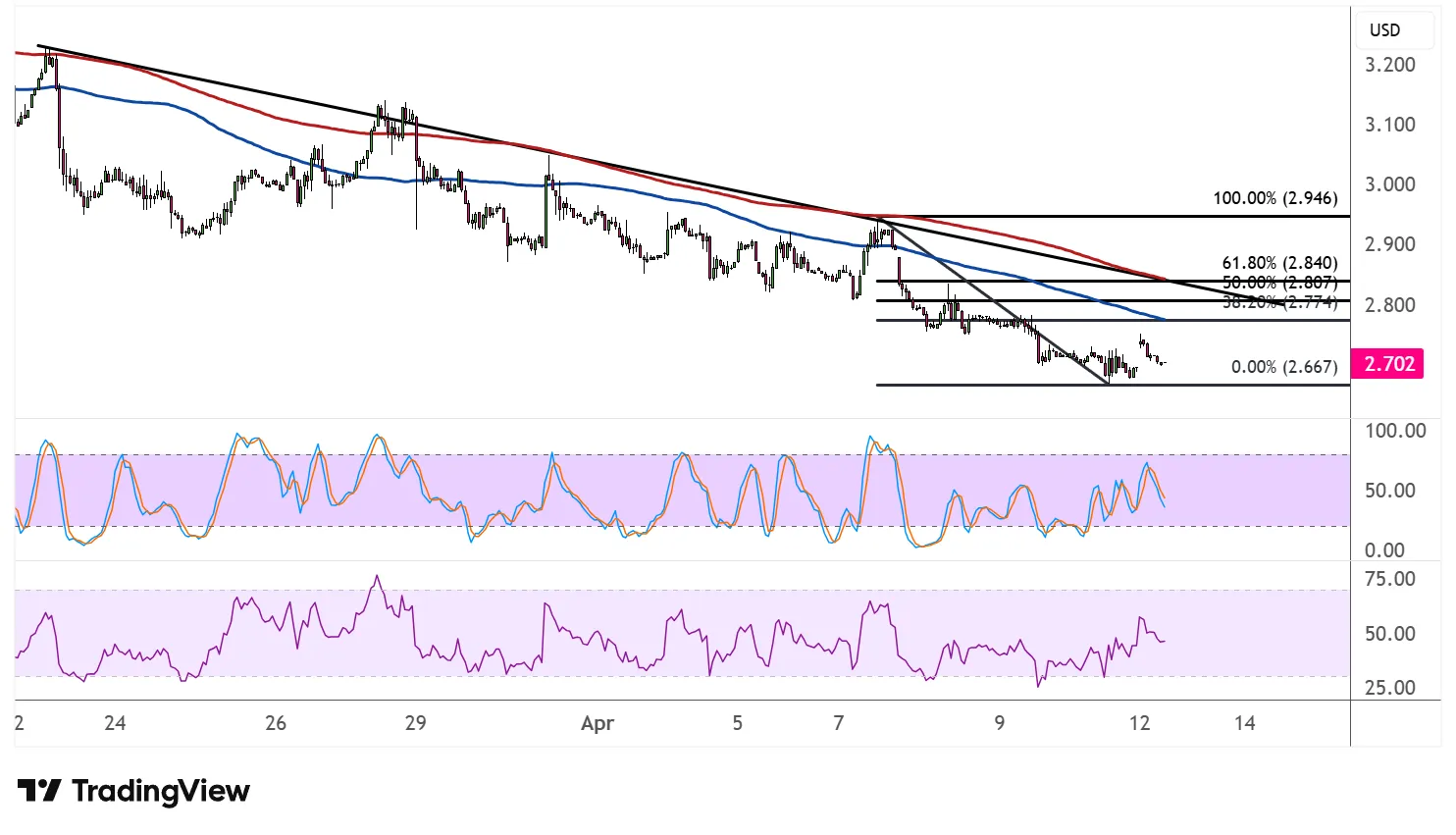
The 100 SMA is below the 200 SMA to confirm that the path of least resistance is to the downside, or that the selloff is more likely to gain traction than to reverse. Both moving averages are sloping lower and sitting above current price, reinforcing the bearish structure and suggesting they could act as dynamic resistance on any pullback attempts.
Stochastic is turning higher from the midrange, indicating that buyers still have some room to push price into the Fibonacci retracement zone before momentum fades. If the oscillator reaches the overbought region near these Fib levels and rolls back over, that could be a signal that sellers are regaining control.
RSI is similarly climbing from below the midline with room to run, suggesting the corrective bounce may have legs in the near term, though a rejection before reaching overbought territory would reinforce bearish conviction.
If any of the Fibonacci retracement levels hold as a ceiling, natural gas could resume the slide toward the swing low at $2.667 or extend losses further south. Geopolitical headlines could continue to influence energy markets, though the latest breakdown in US-Iran peace talks could keep supply risks elevated.