
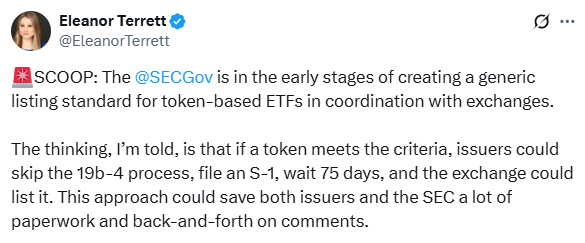
The U.S. Securities and Exchange Commission (SEC) is working on an all-inclusive listing framework in the case of token-based ETFs. As per the popular journalist Eleanor Terrett, the U.S. SEC is going through initial phases of collaborating with top exchanges to establish a universal listing agenda for token-based ETFs. The journalist took to social media to offer insights into the securities regulator’s efforts to develop the respective framework.
SEC Endeavors to Develop Listing Framework to Facilitate Token-Based ETFs

The journalist revealed that the U.S. SEC is now paying substantial attention to the creation of a thorough framework for the listing of token-based ETFs. The journalist is of the view that the latest agenda could permit issuers to circumvent the existing paperwork-heavy and time-consuming 19b-4 procedure. Hence, in line with the proposed mechanism, if a token fulfills predefined criteria, the platform issuing ETFs could just submit an S-1 registration statement. Following a seventy-five-day waiting phase, the product can be listed on the crypto exchange.
In this respect, in terms of meeting the criteria, the issuer gets the opportunity to skip the lengthy 19b-4 procedure. Thus, the SEC and issuers could save a great amount of paperwork with the respective approach. At the moment, the particular criteria for eligible tokens are still under development.
Trending Now: Bitget Launches GetAgent to Automate, Optimize Crypto Trading
However, there is a speculation that the benchmarks will most likely be based on liquidity, trading volume, and market capitalization. The respective benchmarks are potentially being evaluated to guarantee the integrity and stability of token exchange-traded funds before the get permission to be traded on open markets. Apart from that, the SEC is expected to pay a huge attention to resilient compliance frameworks, transparent pricing, secure custody options, and market surveillance.
Bolstering Token-Based ETs’ expansion of Token-Based Exchange-Traded Funds in U.S.
According to Eleanor Terrett, the issuers of ETFs will additionally be needed to show know-your-customer (KYC) and anti-money laundering (AML) protocols. Moreover, they are also supposed to guarantee that the core crypto assets are liquid, manipulation-resistant, and mature. Keeping this in view, if implemented, the cutting-edge universal standard would have the potential to massively expedite the advancement of the U.S.-based token-based ETFs, enabling wider and relatively regulated reach to cryptocurrency economies.