
The USD/CHF pair improved in Friday’s trading session, closing by 0.15% at around 0.8830. This comes after consistent declines, giving the bears some breathing room amid fluctuating Personal Consumption Expenditures (PCE) numbers released by the United States.
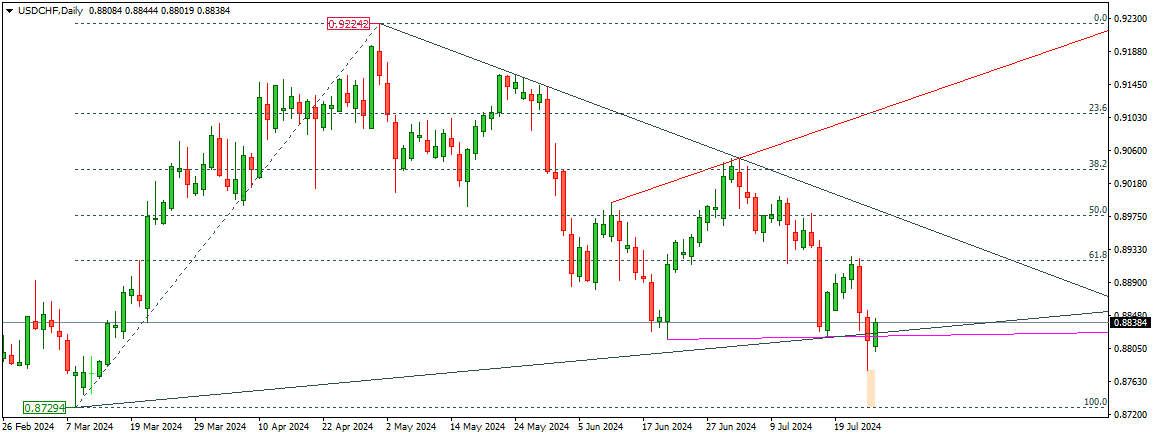

According to the US Bureau of Economic Analysis, US inflation, as indicated by the change in the PCE Price Index, marginally declined to 2.5% year-on-year in June from 2.6% in May. These figures met market expectations. Every month PCE Price Index saw a 0.1% rise after no change in May. Notably, the core measure came in higher than expected, increasing by 2.6% YoY compared to the anticipated 2.5%.
From a broader perspective, the robust growth combined with mild disinflation in the US economy suggests that the Federal Reserve may not be as aggressive in cutting the funds rate, contrary to current market sentiment. Fed Funds futures are currently pricing in nearly three rate cuts of more than 60 basis points by December 2024, with a total easing of 136 basis points projected over the next year. This scenario leaves room for an upward revision of Fed funds rate expectations, potentially boosting the USD and Treasury yields and prompting upward movements in the USD/CHF pair.
Technically, the outlook for USD/CHF remains bearish despite Friday’s gains. The pair closed the week with a 0.70% loss, marking its fourth consecutive losing week and a 1.50% decline since late June. Additionally, the pair continues to trade below the 20, 100, and 200-day Simple Moving Averages (SMA), with indicators persisting in negative territory.
USD/CHF support levels remain at 0.8750 and 0.8730, while resistance levels are suggested at 0.8800, 0.8830, and 0.8850, hinting at a possible upswing.
Trade Idea:
Consider short-term long positions on USD/CHF, targeting resistance at 0.8850 and a stop loss below 0.8750 to manage downside risk amid the potential for an upward revision in Fed rate expectations.