
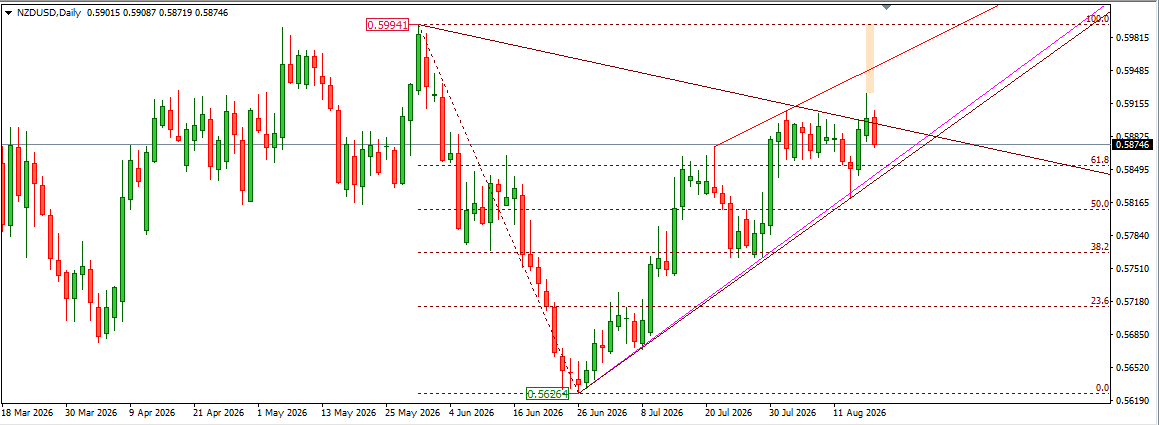
NZD/USD is trading near 0.5880 on Tuesday, down around 0.38% as the New Zealand Dollar remains under pressure from rising geopolitical uncertainty. Escalating tensions between the United States and Iran have increased risk aversion across markets, supporting demand for the safe-haven US Dollar and weighing on risk-sensitive currencies such as the Kiwi.

US President Donald Trump stated that he does not intend to extend the expiring agreement with Iran, emphasizing the use of a naval blockade on Iranian ports as a strategic tool. His comments, along with renewed discussions over control of the Strait of Hormuz, have increased concerns about further escalation between Washington and Tehran. The weaker market sentiment has reduced appetite for higher-risk assets, creating headwinds for NZD/USD.
However, gains in the US Dollar may remain limited as expectations for Federal Reserve tightening continue to fade. Recent weakness in July employment data and moderate inflation figures have reduced the likelihood of an immediate rate increase. Market pricing now reflects a lower probability of a Fed hike at the next meeting, which could restrict further USD strength.
Investors are awaiting the release of the Federal Open Market Committee meeting minutes on Wednesday for additional clues regarding the Fed’s policy outlook. Any shift in expectations could trigger increased volatility in the Dollar.
Meanwhile, the New Zealand Dollar continues to receive some underlying support from expectations that the Reserve Bank of New Zealand may raise interest rates by 25 basis points at its upcoming meeting. Foreign demand for New Zealand government bonds has also remained strong, with offshore investors increasing their holdings, providing additional support for the currency.
Despite this, analysts remain cautious about expectations for multiple RBNZ hikes. Recent inflation indicators show easing price pressures, with core inflation slowing significantly, suggesting the central bank may adopt a more measured approach. Stronger domestic activity data offers some optimism, but real consumer spending remains subdued when adjusted for inflation.
Trade idea: NZD/USD remains bearish below 0.5900; consider selling rallies toward resistance with targets near 0.5840 while monitoring Fed minutes and geopolitical developments.