
The crypto spot ETF sector witnessed divergent flows among the Bitcoin (BTC) and Ethereum (ETH) exchange-traded funds. As per the data from Spot On Chain, Bitcoin ETFs saw $744.3M in net inflows while Ethereum ETFs recorded $102.9M in net outflows between 17 and 21 March. In this respect, Bitcoin ETFs see a continuous bullish momentum while Ethereum ETFs face a bearish sentiment among the investors.
BTC ETFs Add $785.6M over Six Consecutive Days
Spot On Chain’s data points out that the Bitcoin ETFs have seen net inflows for Six consecutive days. In this respect, the cumulative inflows of these exchange-traded funds reached a staggering $785.6M. Particularly, the iShares Bitcoin Trust ($IBIT) ETF of BlackRock dominated this inflow spree by solely adding a big amount of $105M.


Overall, during the recent 5 days, Bitcoin ETFs cumulatively obtained a $744.3M, signifying a huge investor confidence in $BTC ETFs. Particularly, on March 21, Bitcoin ETFs beheld an $83.1M in net inflow, this further increased the current bullish trend. Following up to 299 days of trading, the total net inflow for all eleven Bitcoin ETFs has reached a remarkable $36.17B.
ETH ETFs Record $389.2M in Net Outflows over Thirteen Consecutive Days
On the other hand, Ethereum ETFs are going through massive headwinds with lengthened capital outflows. This day marks the 13th consecutive trading day with net outflows. During the recent 2.5 weeks, a cumulative $389.2M has left $ETH ETFs. Within the past week, Ethereum ETFs recorded $102.9M in the total outflows, showing a diminishing investor interest in $ETH investment products.
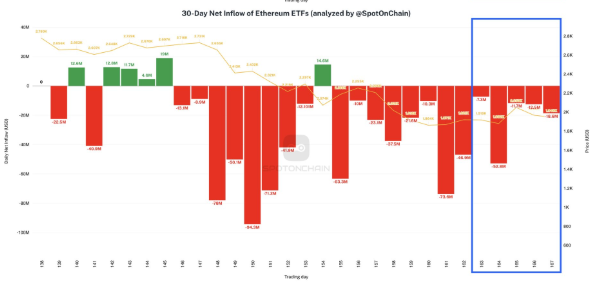
On the 21st of March, Ethereum ETFs witnessed $18.6M in net outflow, further increasing the losses. Since the inception of the $ETH ETFs, the total net inflow for all 9 Ethereum ETFs stays at $2.45B. According to Spot On Chain, the contrasting flows of Bitcoin and Ethereum ETFs indicate the increasing adoption of $BTC while a decreased interest in $ETH as investment vehicles. Keeping this in view, the market onlookers keep watching for the macroeconomic conditions and regulatory developments to measure these ETFs’ future trajectory.