
Forex trading is one of the most popular ways of making money from the global financial markets. The emergence of CFDs on most forex trading platforms has continued to drive growth in this exciting market. And as more traders join the market, a good percentage continues to net profits while others still can’t find success.
History has shown that picking strategies to follow while trading can yield great results. Most of these strategies are a little complicated while others are straightforward. One of the most interesting trading strategies today is the Wolfe Wave Trading Strategy.
How the Wolfe Wave Trading Strategy Works

This strategy helps traders to predict where the price is heading and when it will get there. It can be applied on multiple time frames ranging from 1-minute candlestick chart to one-month chart. It is made up of 5 waves, showing demand and supply with price fighting towards the equilibrium level.
This strategy was developed by Bill Wolfe, a renowned S&P 500 index trader, and has since been confused with the more popular Elliot waves, although there are some distinct differences. Generally, traders talk of a bullish, bearish or sideways trend.
However, during the course of these trends, the price of the stock never really moves in a straight line. It is never a continuous upward movement, there are always some dips and rebounds during the course of the trend.
Specifically, an upward trending price will demonstrate a series of higher highs, and higher lows, which means the succeeding top and bottom prices of the asset will be higher than the previous top and bottom prices.
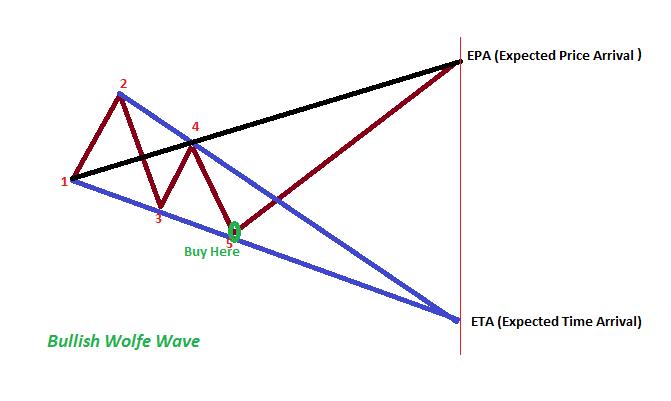
At some point the sequence of higher highs and higher lows in the case of an upward trending movement comes to an end, and is followed by a lower low, which then could potentially set up a reverse trend of lower lows and lower highs. In technical analysis, it is possible to map up the sequence of these trends in a 1,2,3,4,5 price points, with 1 being the start of the wave and 5 being the point that marks a possible end of a trend.
In an upward trending wave, points 1, 3, and 5 mark the resistance rebound levels while point 2 and 4 mark the upward trending support levels. These markings are reversed in a downward trending Wolfe wave.

The upward trending Wolfe waver signals a potential downward reversal when the price of the stock hits the fifth point in the trend, which means that generally, this is a signal for a bearish reversal. On the other hand, a downward trending Wolfe wave signals a potential upward reversal when the price of the stock hits the fifth point on the trend, meaning a bullish reversal could be on the cards.
Generally, EPA is the point where you should place your take profit limit while your stop loss should be placed adjacent to the ETA level. Additionally, as depicted in the diagrams, both points should line up on the same vertical.
Real life illustration
The Wolfe Wave trading strategy is very popular among swing traders and can be applied on the 1 hour, 4 hours and daily time frames to great effect. It also works well in very liquid markets which means that traders can use it well in trading Apple (NASDAQ: AAPL) shares via CFDs on a forex trading platform, or in the forex market, which is the most liquid market in the global financial markets. The example below illustrates a potential case of a bullish Wolfe Wave in the stock price of Apple, between Dec. 2014 and Feb. 2015.
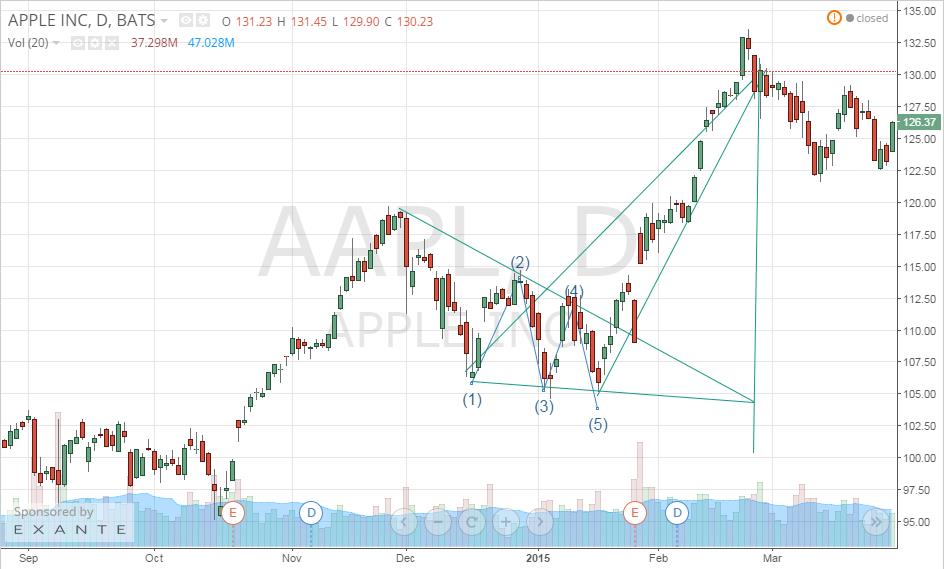
In this example, placing a buy trade at the 5th rebound point when the shares were trading at about 105 and selling when the stock price peaked at about 132 in late February 2015 would have resulted in about 25% gain within a period of just over two months.
Conclusion
In summary, the Wolfe Wave trading strategy might be common in trading stocks, but it could work even better in a more liquid market like the forex market, which experiences more than $5 trillion in average daily turnover. It is a very simple strategy to work with because of the clear steps that traders can look out for in a trade pattern before initiating a trade to profit from the Wolfe Wave trading strategy.
Rate This Post:
[ratings]