
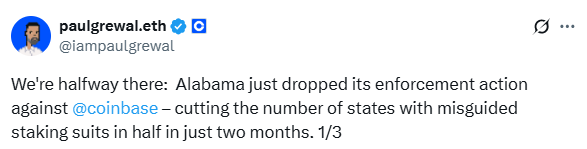
Coinbase, the top crypto exchange in the United States, has seen another achievement in its ongoing legal proceedings. As per Paul Grewal, the Chief Legal Officer of Coinbase, Alabama has formally pulled back from enforcement action that it filed against Coinbase, denoting a noteworthy achievement for the crypto sector. The executive took to social media to announce this remarkable development.
Alabama Drops Enforcement Action Filing Against Coinbase
In a recent thread of posts shared on X, Paul Grewal expressed excitement about Coinbase’s latest victory against Alabama. In this respect, Alabama has officially withdrawn the filing for enforcement action against Coinbase. Ths denotes a key triumph for Coinbase in its current legal battle in the case of staking services. This victory further decreases the number of states having lawsuits lined up confronting Coinbase in only 2 months.

The crypto exchange has been going through several legal disputes with many state regulators in the case of staking services dealing with crypto. This is a feature that permits consumers to get rewards by taking part in diverse proof-of-stake mechanisms. Coinbase, as well as its supporters, advocate for staking as a legitimate service that the decentralized networks provide. Nonetheless, some state regulators consider staking services to be a part of unregistered securities offerings.
Trending Now: $TRUMP Up 53% after Trump Announces Dinner for Top Holders
As Alabama is withdrawing the enforcement action against Coinbase, just 5 states are left on the list. Out of these 4 have even gone too far, prohibiting staking through Coinbase. The Chief Legal Officer of the crypto exchange condemned these states, asserting that they are showing futile legal aggression. Hence, while wasting the resources of taxpayers, they are reportedly depriving users of their right to earn on their preferred platform.
Legal Pullback Underscores Shift in Legal Approach
Moreover, Grewal also pointed toward the significance of a comprehensive federal legislation to deal with the patchwork of disputes at the state level. This could eliminate the confusion for businesses and consumers alike. Thus, there is a need for an exclusive congressional action. At the moment, Alabama’s decision may highlight a shift in the regulatory approach.