
The Australian Dollar (AUD) extended its gains for the fourth successive Friday, driven by persistent high inflation and expectations that the Reserve Bank of Australia (RBA) will delay potential rate cuts.

The minutes from the RBA’s meeting revealed that the board judged the case for holding rates steady to be stronger than hiking, highlighting the need to remain vigilant regarding upside risks to inflation. The data suggested an upside risk for May’s CMay’ser Price Index (CPI), contributing to the AUD’s sAUD’sth.
The AUD/USD pair also benefits from a weaker US Dollar (USD), which has been struggling due to softer economic data from the United States. This has fueled speculations that the Federal Reserve (Fed) might reduce interest rates in 2024. However, the recovery in US Treasury yields could support the USD.
Traders are awaiting the US employment reports on Friday, which are expected to slow employment growth in June. The US Nonfarm Payrolls (NFP) are projected to increase by 190,000 new jobs, down from the previous reading of 272,000. US Average Hourly Earnings are anticipated to moderate slightly, decreasing to 3.9% year-over-year from the prior 4.1%.
The Australian Bureau of Statistics reported a trade surplus for May of A$5,773 million, lower than the expected A$6,678 million and down from the previous reading of A$6,548 million. Retail Sales increased by 0.6% MoM in May, exceeding market expectations of a 0.2% increase, while Judo Bank’s Bank’slia Services PMI rose to 51.2 MoM, surpassing the forecasted drop to 50.6. The Composite PMI also rose to 50.7 MoM, compared to 50.6 in the previous month.
China’s Purchasing Manager Managers’ (PMI) fell from 54.0 in May to 51.2 in June, according to the latest data released by Caixin, below the market forecast of 53.4.
The US ISM Services PMI fell sharply to 48.8 in June, the steepest decline since April 2020 and well below market expectations of 52.5. The ADP Employment report showed that US private businesses added 150,000 workers in June, the lowest increase in five months and below the expected 160,000.
Federal Reserve Bank of Chicago President Austan Goolsbee indicated that bringing inflation back to 2% will take time and that more economic data is needed. Meanwhile, according to Reuters, Fed Chair Jerome Powell stated that the central bank is returning to a disinflationary path.
Trade Idea
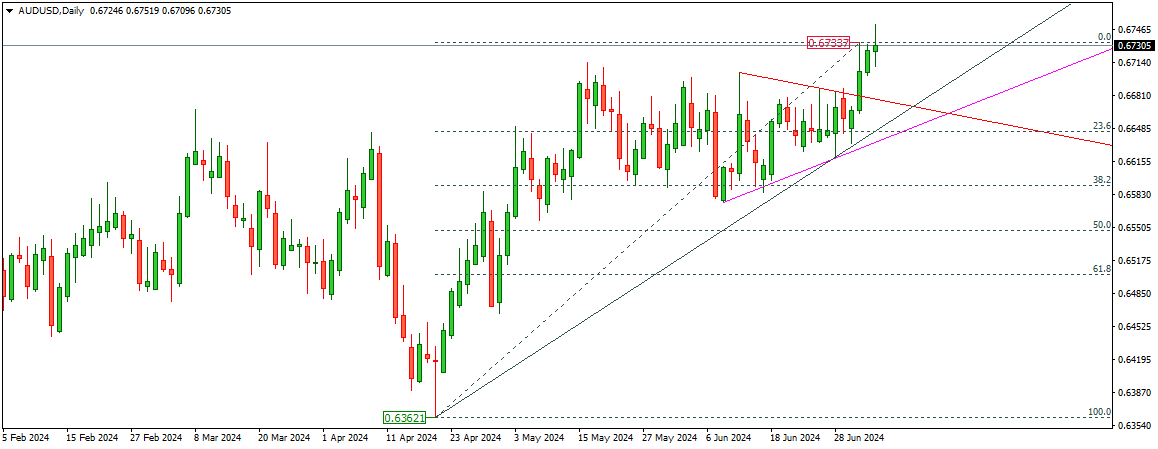
High inflation in Australia and a weaker USD support the AUD/USD pair, suggesting further upside potential.