
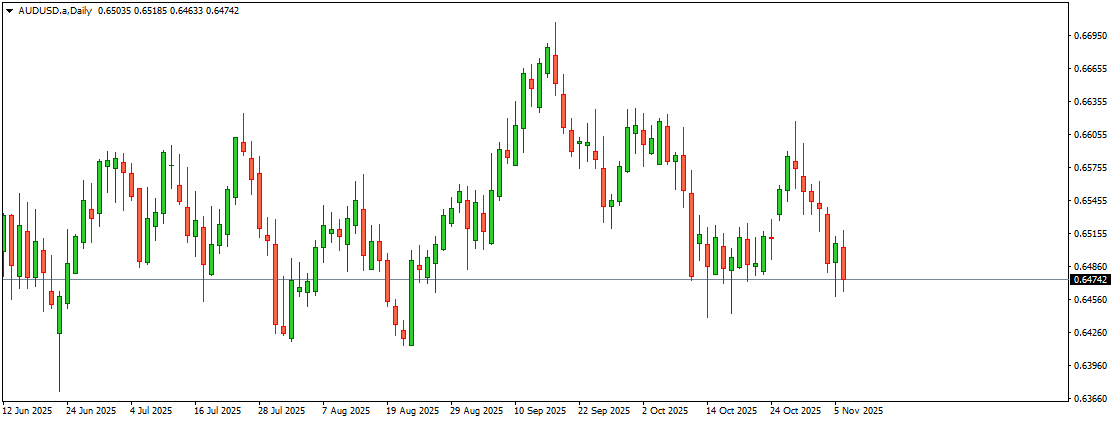
The Australian Dollar (AUD) reversed Wednesday’s brief recovery, with AUD/USD slipping back below the critical 0.6500 level as the pair resumed its broader weekly downtrend. The decline came despite some profit-taking in the US Dollar (USD), which remains broadly supported amid fading expectations of a December Federal Reserve (Fed) rate cut and cautious market sentiment surrounding the prolonged US government shutdown.

The ongoing budget impasse in Washington, now officially the longest in history, continues to cloud investor confidence and cap risk appetite. Still, resilient US data and diminishing prospects of near-term policy easing by the Fed have helped underpin the Greenback, limiting the upside for the Aussie.
Domestically, Australia’s economy remains steady but is showing early signs of strain. The latest October PMI figures were mixed, with manufacturing falling back below the 50 threshold to 49.7, while the services sector improved to 53.1. Retail sales climbed 1.2% in June, and the trade surplus widened to A$3.938 billion in September. Business investment also picked up in the second quarter, lifting GDP by 0.6% quarter-on-quarter and 1.1% year-on-year—figures that reflect moderate but stable growth.
However, labour market indicators hint at a cooling trend. The unemployment rate rose to 4.5% in September from 4.3%, while job growth slowed to 14.9K. The Reserve Bank of Australia (RBA), which held its benchmark rate at 3.60% for the second consecutive meeting, continues to signal patience. Governor Michele Bullock reiterated that policy remains “close to neutral,” noting sticky inflation and a still-tight labour market. She also emphasized that the 75 basis points of previous rate cuts have yet to fully filter through the economy.
Externally, Australia’s outlook remains closely linked to China’s performance. Chinese GDP expanded 4.0% year-on-year in Q3, but soft PMI readings and falling CPI indicate cooling momentum, keeping pressure on commodity-linked currencies like the AUD.
Trade Idea
Sell AUD/USD below 0.6500, targeting 0.6460 and 0.6420, with a stop-loss above 0.6530, as weak data and China’s slowdown weigh on the Aussie’s outlook.