
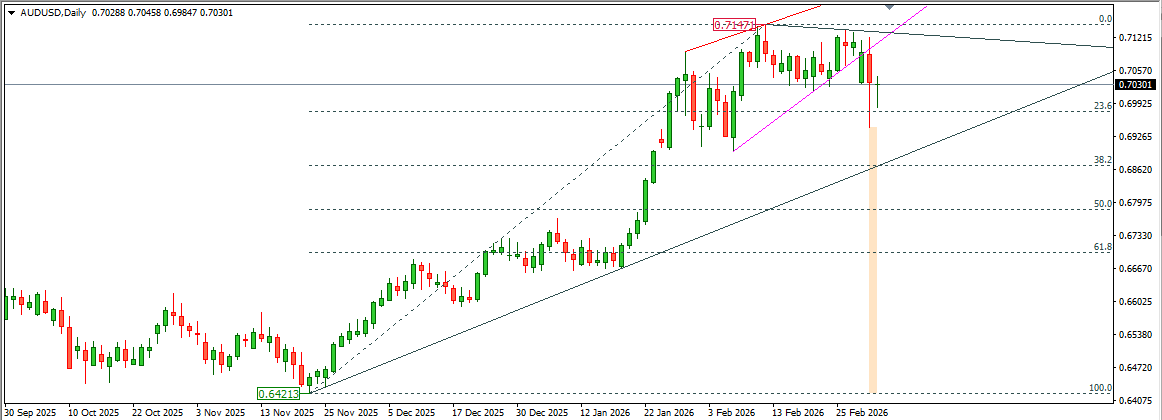
AUD/USD extends its decline for a second straight session, trading near 0.7010 during Wednesday’s Asian hours. The pair remains under modest pressure even after Australia reported stronger-than-expected economic growth, as broader US Dollar strength and shifting rate expectations weigh on the Aussie.

According to data from the Australian Bureau of Statistics, Australia’s economy expanded by 0.8% quarter-over-quarter in Q4 2025, accelerating from 0.5% in the previous quarter and beating forecasts of 0.6%. On an annual basis, GDP rose 2.6%, up from 2.1% in Q3 and above the 2.2% market consensus. The upbeat growth figures suggest that domestic demand remains resilient, offering a supportive backdrop for the Australian Dollar.
However, business activity indicators signaled some moderation. Final data from S&P Global showed the Australia Services PMI easing to 52.8 in February from 56.3 in January, indicating continued but slower expansion in the services sector. The Composite PMI also declined to 52.4 from 55.7. Although private-sector output has now expanded for seventeen consecutive months, the pace of growth has cooled since the beginning of the year.
Meanwhile, the US Dollar has regained traction as expectations for near-term interest rate cuts from the Federal Reserve continue to fade. Firm economic data and rising inflation risks have prompted investors to reassess the likelihood of policy easing in the coming months. Higher Oil prices, fueled by escalating tensions in the Middle East, have further intensified inflation concerns and reinforced the view that US rates may remain elevated for longer.
Despite renewed calls from US President Donald Trump for lower borrowing costs, markets largely anticipate that the Fed will keep rates steady at least until summer. This policy divergence narrative is limiting AUD/USD’s upside, leaving the pair vulnerable to additional downside if US data surprises to the upside.
Trade idea:
Sell below 0.7020 targeting 0.6950 and 0.6900; stop above 0.7070 to manage risk if momentum shifts on stronger Australian or weaker US data.