
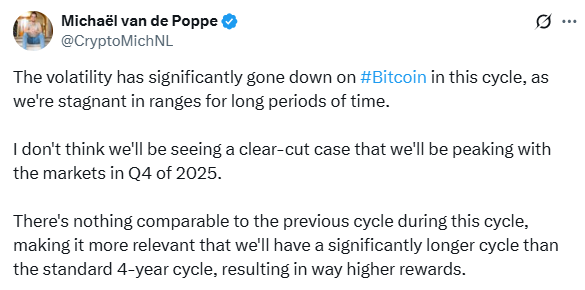
Bitcoin ($BTC) market is reportedly experiencing a decrease in volatility in line with the latest market statistics. As per the data from Michaël van de Poppe, amid the currently diminishing Bitcoin ($BTC) volatility, it seems that its cycle could be prolonged beyond 2025. The latest social media post shared by the prominent crypto analyst reveals the possibility for this Bitcoin cycle to peak in 2026 or 2027. Hence, it seems to be highly unlikely for the flagship crypto asset to climb to another cycle peak during this year.
Bitcoin Volatility Plunge Indicates Potential of Extended Market Cycle

In his discussion on the current market cycle of Bitcoin ($BTC), Michaël van de Poppe mentioned that the volatility has substantially dropped. This is an indication that the present cycle will extend beyond the present year. Additionally, amid the stagnant price movement, the market uncertainty is also growing among long-term holders and traders alike.
Based on the new data, the idea of reaching the cycle peak in 2025’s 4th quarter seems unlikely to materialize. Normally, this theory is pushed forward by those believing in the 4-year halving-based market cycle. While backing his argument, the analyst asserted that the present cycle has no resemblance to the former cycles.
Trending Now: Crypto Market Sees $223 million Weekly Outflows, First Dip in 15 Weeks
In this respect, the ongoing cycle cannot be compared with the historical instances because of irrelevance. At the moment, the market is reportedly witnessing a structural evolution. The respective deviation potentially fortifies the idea of extended market cycle. Therefore, Michaël van de Poppe is of the view that a relatively prolonged timeline could lead to massively increased returns for patient holders.
Ongoing BTC Cycle to Peak in 2026 or 2027: Analyst
Michaël van de Poppe added that, while viewing Bitcoin’s ($BTC) overall market outlook, it is more appropriate to say that this cycle will be significantly longer. Thus, the peak of this cycle is anticipated to occur during 2026 or 2027. This reportedly points toward the changing wider crypto dynamics, affected by increasing institutional interest, evolving investor behavior, and macroeconomic uncertainties. Overall, this analysis reminds crypto traders of the significance of adaptability and patience as the essential traits of the ever-evolving crypto market.