
A recent wave of media reports suggesting a sharp decline in Bitcoin’s market liquidity has been called into question by crypto analyst Axel Adler. He argues that the narrative is based on a misinterpretation of on-chain data. In his tweet on X, Adler clarified the situation, pointing to Bitcoin (BTC) Realized Capitalization as a key metric that paints a more clear picture of the cryptocurrency’s financial health.
Realized Capitalization Growth Debunks Bitcoin Liquidity Concerns

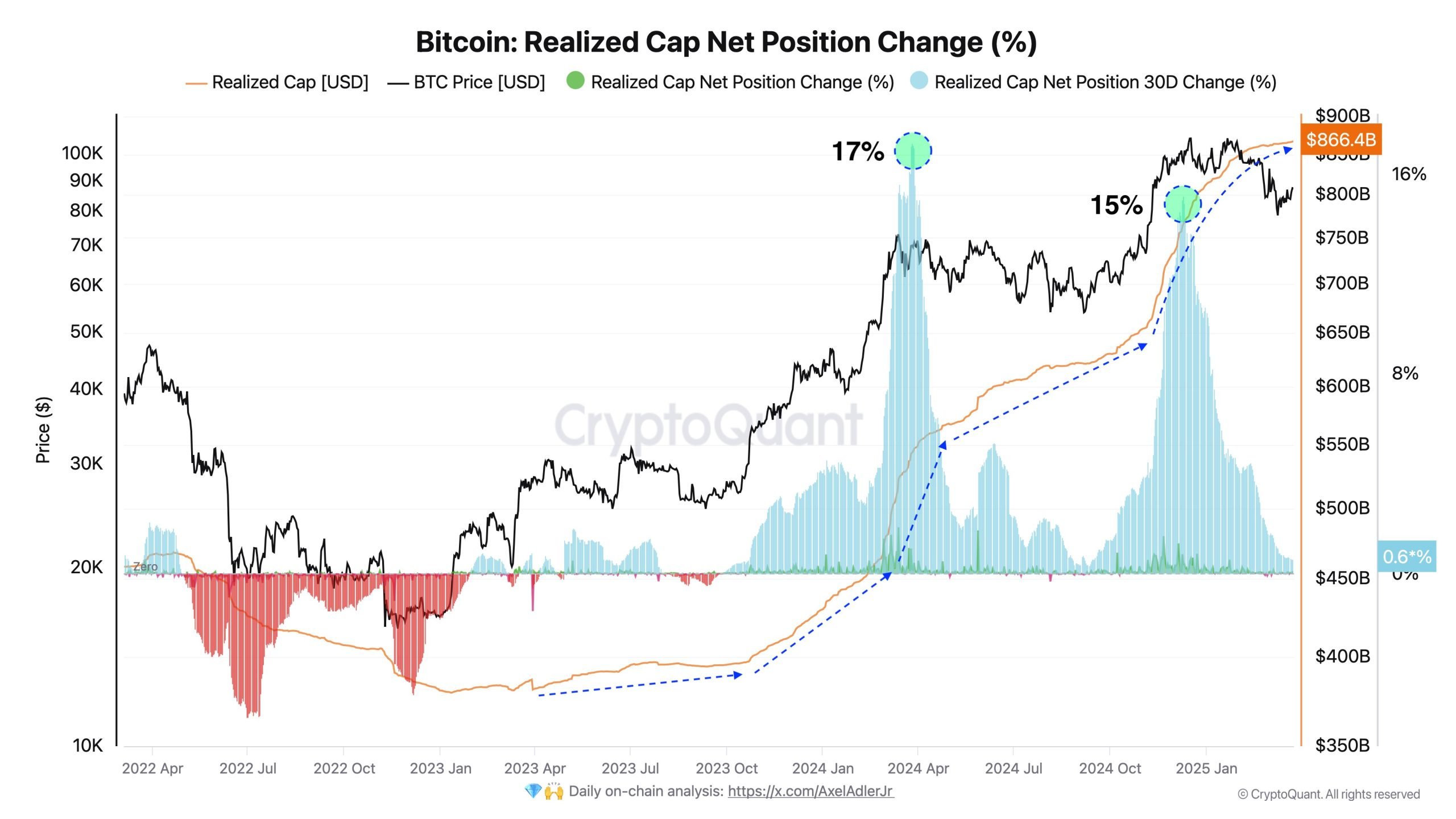
Adler shared a chart from CryptoQuant illustrating Bitcoin’s Realized Capitalization and its net position change over the past few years. The chart shows that Bitcoin’s Realized Capitalization has been steadily climbing since April 2023. Currently, it is standing at an impressive $866 billion. However, the rate of growth in new capital entering the market has slowed to 0.6% per month, a deceleration that some media outlets misinterpreted as a sign of dwindling liquidity.
Trending Now: Bitcoin On-Chain Metrics Flash Bearish, Bull Run Still Not Over
The distinction is critical for understanding Bitcoin’s market dynamics. Liquidity, which measures how easily an asset can be bought or sold without significantly impacting its price, is influenced by a variety of factors, including trading volume and market depth. Realized Capitalization, on the other hand, reflects the total value of all Bitcoins based on their last transaction price. While a slowdown in capital inflows might suggest reduced speculative activity, it doesn’t necessarily translate to a liquidity crisis, as Adler pointed out.
BTC Liquidity Remains Strong Amid Growing Realized Capitalization
Supporting Adler’s analysis, recent data from Investopedia highlights that Bitcoin’s average 24-hour trading volume between January and August 2024 was $32.1 billion, a figure that is lower than the forex market’s daily turnover of $7.5 trillion. However, it still indicates a robust level of liquidity for the cryptocurrency. The asset’s ability to maintain growth in Realized Capitalization, now up to $866 billion, further supports the view that Bitcoin remains a maturing store of value, often compared to gold.
As the cryptocurrency market continues to evolve, it is pertinent to look beyond surface-level metrics and consider the broader context of on-chain data. For now, Bitcoin’s liquidity appears to be holding steady, with its Realized Capitalization signaling sustained confidence in the world’s leading cryptocurrency.