
The positive numbers from the Ivey purchasing managers’ index (PMI) impacted the CAD/JPY currency pair on Monday.
The Ivey Purchasing Managers Index in January stood at the position of 48.4 as compared to the month before data of 46.7.

In Canada, the Ivey PMI captures business conditions. An important indicator of business conditions and the overall economic situation in Canada is the Ivey PMI. For CAD, a result above 50 is positive or bullish, while a result below 50 is negative or bearish.
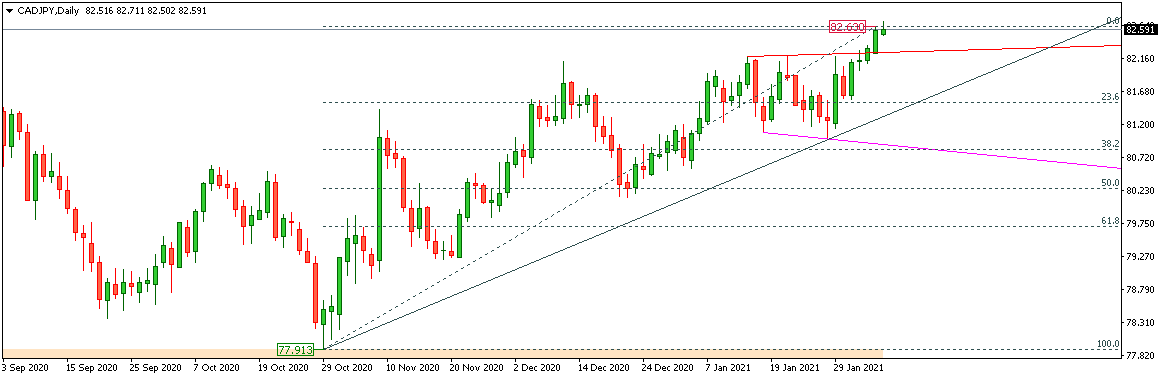
Although the CADJPY is continuously on the road of success and hence today it reaches to the price of 82.56. But yesterday the Ministry of Finance of Japan released the Current Accounts of December with the status of ¥1165.6 B, as compared to the month before data of ¥1878.4 B, which might not help the CADJPY for its forward movement.
The current account is the net flow of current transactions into and out of Japan, including the payment of goods, services, and interest. A surplus in the current account indicates that the flow of capital into Japan exceeds the reduction in capital. A deficit in the current account indicates there is a net outflow of capital from these sources. For JPY, a high reading is positive, whereas a low reading is negative.
Conclusion
The technical bias remains bullish because the price printed a higher high in the recent upside move. Hence, the selling of CADJPY would be the suitable option for generating the quick profit to short-medium trading.