
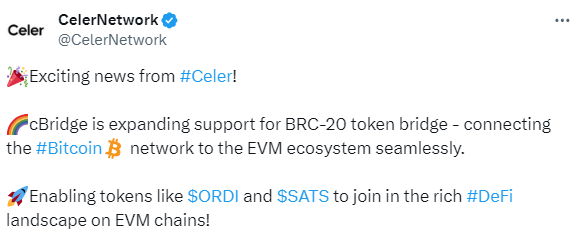
Celer cBridge, a prominent blockchain communication technology, is making significant progress in fostering Bitcoin and Ethereum Virtual Machine (EVM) ecosystem interoperability. This strategic endeavor will expand BRC-20 token bridge support to facilitate easy transfers between BRC-20 and ERC-20 tokens across Bitcoin networks and EVM Chains.
Celer cBridge Strengthens Bitcoin-EVM Token Transmission

The growing importance of BRC-20 tokens in Bitcoin drives this expansion. The community has shown interest in tokens like $ORDI and $SATS, heralding a new era of possibilities. However, Bitcoin’s inability to implement Turing-complete smart contracts has limited its participation in EVM Chains’ flourishing decentralized financial (DeFi) ecosystems.
Celer cBridge collaborates with both ecosystems to bridge technological and conceptual gaps rather than just delivering a technical solution. The main purpose is to securely transmit BRC-20 tokens into the varied DeFi ecosystem of EVM chains, increasing liquidity and improving trade. This effort intends to facilitate transactions and create a more inclusive, integrated, and dynamic blockchain universe.
Celer Network Advances Bitcoin-EVM Security in Two-Phase Integration
This integration technique comprises two phases to provide security and trustlessness. Celer cBridge uses the Celer State Guardian Network (SGN) early on. SGN, a Proof of Stake (PoS) network, has secured over $15 billion in cross-chain transactions. The SGN-based BRC-20 bridge secures token movement between the Bitcoin and EVM chains, laying the groundwork for future stages.
Trending Now: Grayscale Bitcoin Trust Advances Spot ETF Bid with Key Amendment
In the second phase, Celer cBridge uses Zero-Knowledge (ZK) proofs to make BRC-20 cross-chain transfers unmatched secure and decentralized. ZK proofs will be required for Bitcoin-EVM chain transactions at this stage, increasing security and complexity. Construction of a BRC-20 zkBridge is complex, especially post-SegWit, unlike normal ZK bridges.
Since Segregated Witness (SegWit) isolates witness data from transactions, BRC-20 cannot rely on transaction Merkle inclusion utilizing a block header to validate witness data. Thus, every BRC-20 zkBridge transaction requires a Zero-Knowledge proof to authenticate the source chain witness data Schnorr signature. Due to the lack of native smart contracts for BRC-20 transaction verification, centralized third parties must provide indexing services. Establishing a trustless BRC-20 zkBridge requires a ZK-proven BRC-20 indexer on the EVM chain. Verifying all past BRC-20 transactions is time-consuming. Integrating with Brevis, a blockchain coprocessor, is a crucial step toward a trustless BRC-20 zkBridge.