
The Chinese yuan strengthened against its major currency rivals to kick off the trading week, despite disappointing economic data. In recent weeks, there have been growing concerns that Beijing could experience a stagnant economy, potentially threatening global growth.
The Caixin services purchasing managers’ index (PMI) fell to 51.4 in January, down from 53.1 in December – anything above 50 indicates expansion. The composite PMI declined to 50.1 last month, down from 53.0 in the previous month.

Both readings highlighted easing new order growth, a drop in foreign sales, and lower employment. Cost pressures swelled, while input costs advanced. Business sentiment declined to a 16-month low.
“That indicated that service enterprises remained concerned about the ongoing epidemic in China,” said Wang Zhe, senior economist at Caixin Insight Group, in a statement.
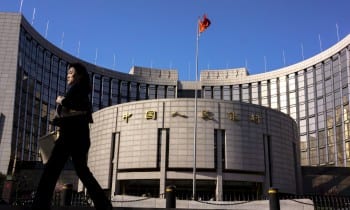
In other data, the People’s Bank of China (PBoC) reported a decrease in foreign exchange reserves, totaling $3.222 trillion in January, down from $3.25 trillion in December.
Meanwhile, market analysts warn that weak consumption during the Lunar New Year could be a sign that the economy is on the cusp of a “worsening economy.”
“Despite a nearly 48 per cent increase in the number of people returning to their hometowns for the Lunar New Year holiday compared with last year, a contraction in movie box office sales and tourism revenues – due perhaps to the worsening economy – suggests that this did not result in materially higher consumption demand,” a Nomura report stated.
“Despite Beijing’s call to front-load supportive measures at the start of this year, we believe GDP growth could slow further [in the first quarter.”
 The gross domestic product (GDP) is still expected to expand 5.4% in 2022 amid loosening fiscal and monetary support mechanisms.
“We aren’t yet revising our GDP forecasts. These currently stand at 4%Year-on-Year growth in the first quarter of this year, and 5.4% for the whole of 2022,” said Iris Pang, the Chief Economist of Greater China at ING Think, in a note.
“This is partly because the People’s Bank of China (PBoC) has confirmed that it will deliver a more accommodative monetary policy in 2022. We expect to see more rate cuts in the 7D reverse repo, 1Y Medium Lending Facility, 1Y and 5Y Loan Prime Rates. As an indicator, we forecast the 7D reverse repo rate to fall from 2.2% at the beginning of the year to 1.7% by the end of the year. This forecast, however, relies on Covid cases remaining limited and confined to small area outbreaks, so the risks are skewed to the downside.”
The USD/CNY currency pair tumbled 0.44% to 6.3327, from an opening of 6.3610, at 13:29 GMT on Monday. The EUR/CNY dropped 0.65% to 7.2348, from an opening of 7.2932.