
The EUR/USD currency pair on Wednesday maintained the current downward momentum dropping below the 1.1600 level for the first time in four days. This came amid mixed sets of events and news during the day that swung the pair modestly above and below the psychological key level.
Early in the day, the US released data for durable goods, which fell less than expected after declining 0.6% in May. Analysts had predicted a decline of at least 1.0%. However, ex-transportation figures missed analyst estimates dropping by 0.3% against a projected gain of 0.5%. On the other hand, pending home sales were also down last month after the figure dropped by 0.5%, making it a fifth straight decline this year, on an annualized basis.

Generally, these items did not affect the strength of the greenback by much as it continues to rely heavily on the overall economic health of the U.S. economy, which when compared to that of the EU, is significantly stronger.
So, this explains why the bears continue to retain control over the pair as the first half of the year 2018 comes to an end.
And while the fears of trade wars between the U.S. versus China and the EU continue to weigh on various currencies including the Euro, the USD seems to thrive in the chaos. Furthermore, the greenback also benefited from Trump’s softened stance on trade wars after he reportedly decided against the harshest measures on China investments. Reports indicate that Trump opted to use an updated version of the existing national security screening process instead of creating a new regime.
So, where does this mixed bag of news and events leave EUR/USD traders? The 4-hourly chart below has a few insightful suggestions.
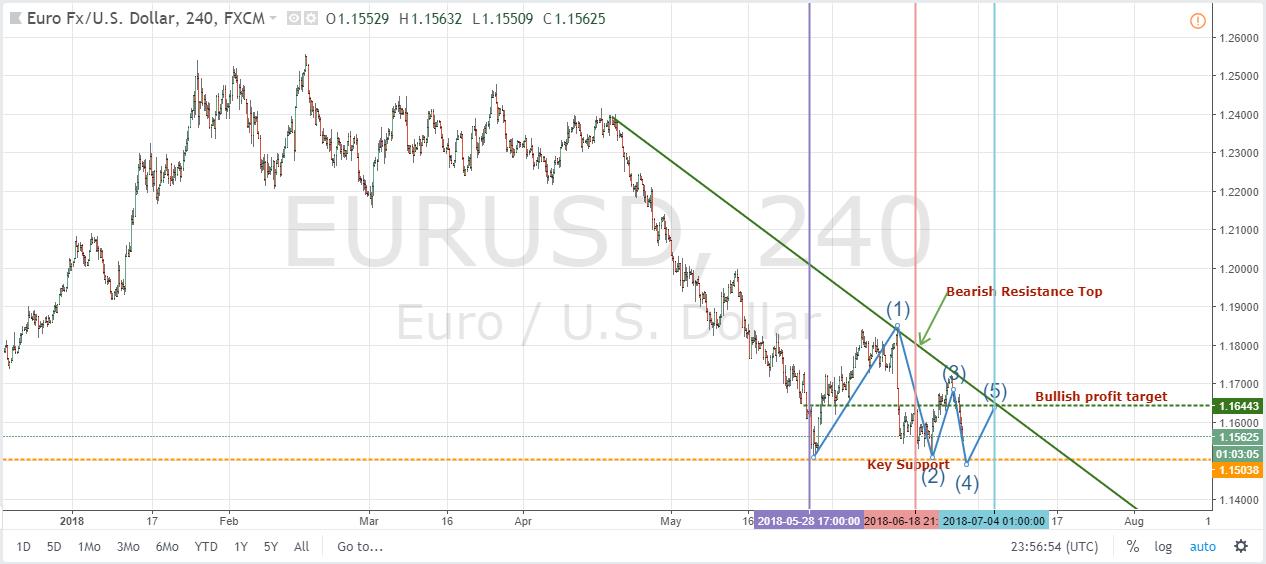
Looking at the EUR/USD chart above, the pair appears to be on a path to completing the Elliott Impulse Wave (12345) pattern with a flat base and a bearishly inclined top. The pair recently hit the third impulse point on the pattern and now seems set to hit the fourth, which will also coincide with a retest of the current yearly lows of about 1.1500.
The 1.1500 has been a key support level over the last five weeks, and this also creates the first opportunity for the bears to target in the short-term.
On the other hand, the opportunities for the bulls this week appear limited unless there is a notable change in market sentiment. This could be triggered if the EU data expected to be released this Thursday is positive based on trader expectations.
Should a retest of the yearly lows fail this week—and a rebound occur, then bullish traders can target profits at around the 1.1650 level, as denoted on the chart above, which would result in up to 100 pips worth of profits.
However, if the short-term turbulence does not create enough opportunities as is the case above, then it is always possible to expand the timeframe to explore more trading opportunities in the intermediate and long-term horizons.
This is when the daily chart below comes in handy. It paints a clearer picture of where things might head in the next few weeks and months.

The daily chart above seems to suggest that the EUR/USD currency pair could be in the process of forming a second shoulder, which would then complete a heads and shoulders bearish breakout pattern. When you look at the pair in the grand scheme of things, the overall health of the U.S. economy is likely to continue to dwarf the Eurozone.
However, it is also possible that there will be instances when positive developments in the Eurozone economy could spark rallies in the EUR/USD currency pair for a few weeks, if not months. This is what could lead to the formation of the second shoulder in the head and shoulders pattern. But in the long-run, the corrective pricing of the pair is expected to kick in thereby resulting in a bearish breakout.
As such, bullish traders will be looking at opportunities that could emanate from this unlikely rebound by targeting profits at (R1) and (R2) at 1.1800 and 1.2000 levels. On the other hand, the bears will look at opportunities positioned at (S1) and (S2), at 1.1450 and 1.1200 levels.
But overall, the EUR/USD currency pair looks certain to retest the current yearly lows of about 1.1500 before rebounding to potentially touch the bearishly inclined top at around the 1.1650 level.