
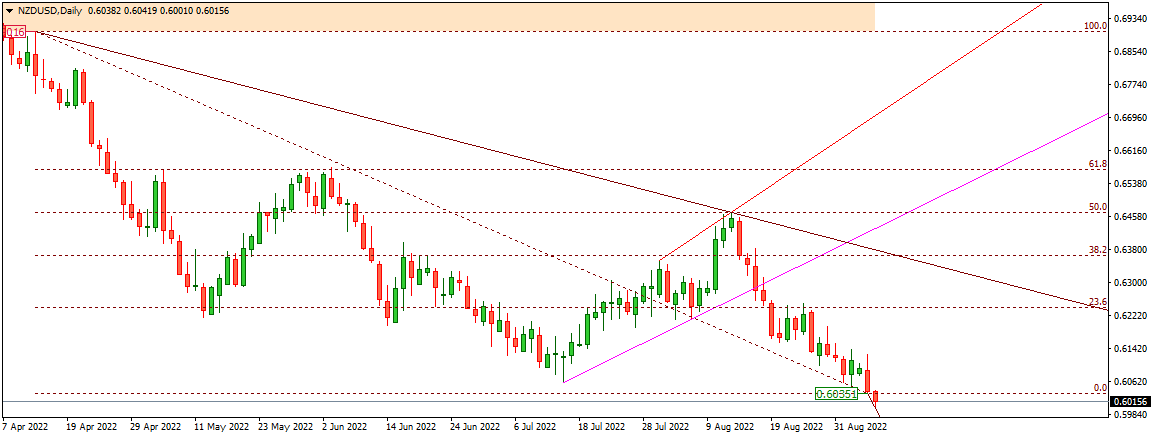
After attempting to fall to 0.6038 in Tokyo, the NZD/USD pair is now dropping. Dollar bulls have gained ground following a break below the consolidation range of 0.6034–0.6053. 0.6030 is the asset’s two-year low.
The demand area of 0.6035 to 0.6063 has become a supply area for NZD/USD bulls after a four-hour drop below it. The likelihood of the asset going down has also increased due to selling pressure as it tests the demand zone.

The RSI (14) has entered the negative 20.00–40.00 range, indicating bearish momentum.
If 0.6030 is breached, the asset will move to 0.6000 and then 0.5910 on April 20, 2020.
The asset will reach the round-level resistance and Friday’s high if it moves above the demand zone between 0.6035 and 0.6063.
According to the US Institute for Supply Management, the Non-Manufacturing PMI rose to its highest level since July at 56.9, exceeding forecasts of 54.9. Prices Paid decreased to 71.5 from 72.3 while New Orders increased to 61.8 from 59.9 in July, indicating that raising interest rates impacts the economy.
The September economic figures further support a 75-bps rate hike. The US industrial and services sectors continued to expand, and nonfarm payrolls exceeded expectations, showing a robust economic outlook, according to the ISM. The last piece of the puzzle is the CPI report for next week.
Conclusion
NZD/USD traders would expose to US dollar dynamics due to Wednesday’s Loretta Mester speech in Cleveland and an empty New Zealand economic calendar.