
The EUR/USD currency pair appeared to halt the current downward momentum and close the day at around the 1.1670 level after oscillating within a range of 1.1660-1.1690. The US Federal Reserve committee’s decision to hold the funds rate at the current level of 1.75%-2.00% as predicted by analysts failed to make a notable impact.
Fundamental Highlights

Last month President Trump raised concerns about Fed’s recent interest rate hikes spiking skepticism in the market regarding the health of the U.S. economy. Trump has been at the forefront of what has been termed as a trade war between the U.S. and China and is expected to increase tariffs on Chinese products worth up to $200 billion from 10% to 25%.
The greenback has remained surprisingly resilient despite the EU and China indicating that they were going to take similar measures and impose stricter tariffs on US goods imported to their countries/regions. While the battle between the Euro and the US Dollar has been a choppy one in recent trading sessions, the overall direction has been a bearish one indicating that the greenback remains stronger on a fundamental perspective.
The recent FOMC comment, which held the funds rate constant after speculations that the market could witness a third hike for the year 2018 seemed to cede some advantage to the Euro but the pair generally holds a bearish bias as we kickstart the month of August. FOMC noted a stronger housing market while the economic outlook also remained strong.
Technical Discussion
So, what does this mean for traders? The hourly chart below can shed some light on how traders can approach the pair through Friday and possibly next week.
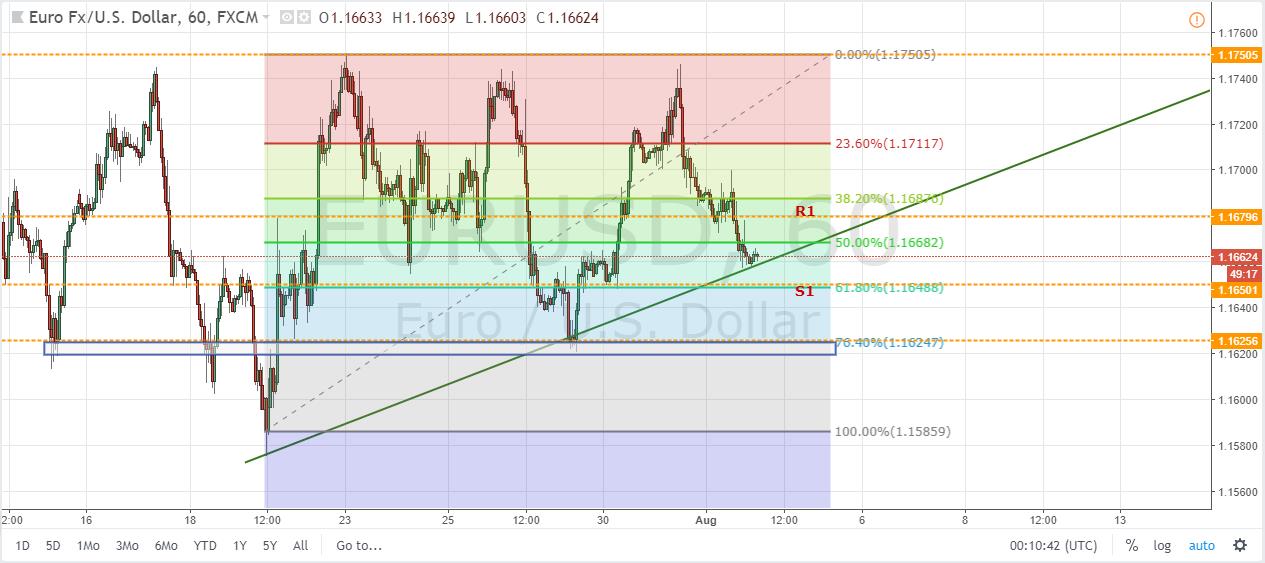
As shown on the hourly chart above, the pair has been very volatile in recent trading sessions and this means that both the bulls and the bears can profit from short-term fluctuations. The bulls can target (R1-1.1680), which based on the current rate of about 1.1660 will result in a few pips (20) of profits.
The bears, on the other hand, can look at potential downward movement by targeting (S1-1.1650) again which results in just about 10 pips worth of profits. These are super short-term trading profits that will only appeal to speed traders, otherwise it would be better to look at the pair with a long-term perspective.
By mapping the chart pattern on Fibonacci retracement, the EUR/USD currency made a bearish break through the 50% retracement level and seems to be heading towards the 61.8% retracement level. This will give the bears optimism as the month of August clears its first week.
Traders can also look for longer trading opportunities by targeting the pair at about 38.2% retracement level for the bulls and 76.40% level for the bears, which will result in bigger profits.
By expanding the analysis to the 4-hourly chart, we get an interesting figure, which seems to indicate the formation of a trend continuation triangle.

Looking at the 4-hourly chart above, the EUR/USD currency pair is currently trading above the major trading zone indicated using a horizontal rectangle. This zone has formed what could be a major resistance section for the pair and as shown on the chart, the pair now seems to be forming a convergence which would trigger the next bearish run.
This will form exciting trading targets for the bears at (S1-1.1624) and (S2-1.1585) as demonstrated on the chart. (S2) is the previous low rejected by the pair late last month while (S1) forms the most recent rebound, which also looks likely to suffer a rejection, in which case, the bulls will be excited to pounce.
So, should the pair reject the most recent rebound and instead rally upwards, the bulls will target (R1-1.1700) and (R2-1.1730) for profits for the intermediate trading timeframe.
Long-term support and resistance zones remain at around the 1.1550-1.1500 level and 1.1780-1.1800 level, respectively. The pair has not topped 1.1780 since July 9 while it bottomed at 1.1550 on July 19. Traders could be looking at a couple of weeks or even months before the pair can reach those levels, if nothing major on a fundamental perspective swings the market.
In summary, the EUR/USD currency pair’s recent movement has been defined by the ongoing trade wars and a flurry of economic data that failed to shake the market. After FOMC’s comment proved ineffective on the pair, traders will be looking at Trump’s action on tariffs and EU’s economic data in the coming days and weeks.