
The British pound fell to an all-time low against the US dollar to kick off the trading week, joining the weakness in the broader forex market. The sterling has been decimated in recent weeks, driven by abysmal economic data and government tax cuts and investment incentives to support growth.
The Bank of England (BoE) essentially conceded that the British economy is in a recession. The central bank recently raised interest rates again as part of its inflation-busting crusade.

But the Conservative government, led by Prime Minister Liz Truss, believes that tax cuts could be the panacea to growing the economy while the BoE combats inflation. But critics warn that these policy prescriptions will result in more money circulating in the economy and the government taking on more debt in a rising-rate climate.
With the latest developments, Nicholas Ferres, chief investment officer at Vantage Point Asset Management, told CNBC that he would not be surprised if the “Bank of England may even do an emergency policy meeting this week and hike rates, that wouldn’t surprise me if that happened.”
Ultimately, the sterling’s performance might come down to fiscal irresponsibility, says Saktiandi Supaat, FX strategist at Maybank.
A broad array of economic measurements has been abysmal. The S&P Global/CIPS Manufacturing Purchasing Managers’ Index (PMI for September remained in contraction territory at 48.5. The UK Services PMI slipped into contraction territory by falling to 49.2. Also, the Composite PMI dropped to 48.4 this month.
But investors will be monitoring the final second-quarter reading, as it might confirm that the UK economy is on the brink of a recession. The consensus is a -0.1% print.
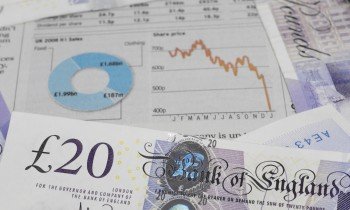 Indeed, the British pound has been in freefall this year, plummeting close to 20% year-to-date. It has lost about 5% in just one week against the greenback.
Meanwhile, the British bond market was up across the board, with the benchmark ten-year yield adding 26.6 basis points to 4.095%. The three-month bill climbed 49.1 basis points to 3.028%, while the 30-year bond jumped 23.4 basis points to 4.284%.
The GBP/USD rose 0.04% to 1.0854, from an opening of 1.0850, at 13:21 GMT on Monday. The currency pair had collapsed to below 1.05 in overnight trading before paring most of its losses. The GBP/JPY pair advanced 0.56% to 156.36, from an opening of 155.49.