
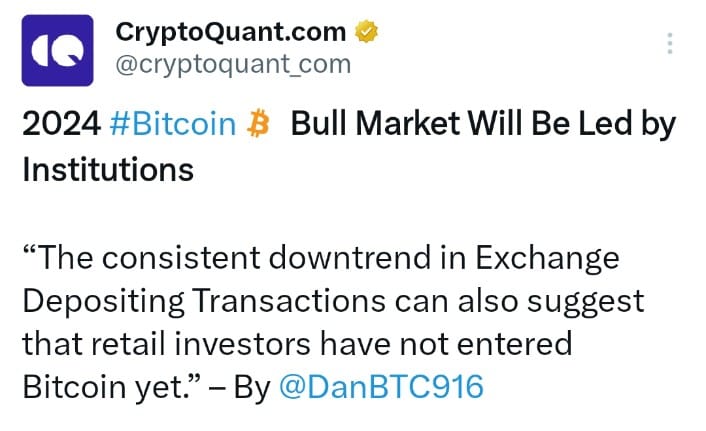
A closer look at historical data shows that the forces driving the current bull market have changed significantly as Bitcoin’s price rises in 2024. During earlier BTC cycles, retail investors were dominant however this time institutional investors are transforming Bitcoin trading and investing. Exchange Depositing Transactions, Mean Exchange Inflow, and Bitcoin Price can reveal market trends and investor behaviour. As per these metrics, CryptoQuant says that Bitcoin trading and investing are changing by comparing these numbers to previous bull and bear market cycles.
2023 Market Stabilization: Rise of Institutional Participation

During the 2021 bull market, small investors boosted Exchange Depositing Transactions. This showed Bitcoin’s speculation appeal. However, the Mean Exchange Inflow metric remained low, suggesting that individual investors traded more than large institutions. Large retail participation and low institutional participation made the market volatile.
However, the 2022 bear market reduced Exchange Depositing Transactions and retail interest. Cryptocurrency consolidation and re-evaluation occurred. The failure of several crypto companies and tokens likely exacerbated the fall, as investors lost faith.
In 2023, as the market stabilized, the Mean Exchange Inflow metric increased but Exchange Depositing Transactions decreased. This difference suggested that larger institutional investors were slowly entering the market and increasing trading activity. This influx of institutional capital indicated a maturing market with more stable and diverse investors.
CME Bitcoin Futures Open Interest Hits Record High
Exchange Depositing Transactions kept falling, indicating that regular people hadn’t fully returned to BTC. Bitcoin Google search trends remained low despite rising prices. Thus, individual interest lagged behind institutional interest.
Spot ETFs (Exchange-Traded Funds) will likely change markets and attract more institutions. Because they allow investors to gain exposure to Bitcoin without owning it, these exchange-traded funds (ETFs) will likely increase trading activity and institutional capital. The Mean Exchange Inflow metric is expected to rise, indicating that institutional investors are becoming more important in Bitcoin.
The record-breaking CME BTC Futures Open Interest shows that institutional investors are increasingly optimistic about Bitcoin’s future. Many people trade Bitcoin futures contracts, which let investors predict its price. Market leaders want to capitalize on the bullish trend.
Ultimately, past data paints an intriguing picture of the 2024 BTC bull market’s evolution. Bitcoin trading and investing are changing as institutional investors become more important. As long as these institutions invest in Bitcoin and other investment products, the market will likely grow and mature.