
In the early European session, the AUD/USD currency pair fell below 0.6700. As US-China tensions over Taiwan reduce market risk appetite, the Australian asset is nearing Wednesday’s low at 0.6675. China is worried that the United States will keep its word, deliver arms to Taiwan on time, and boost economic and technical relations.
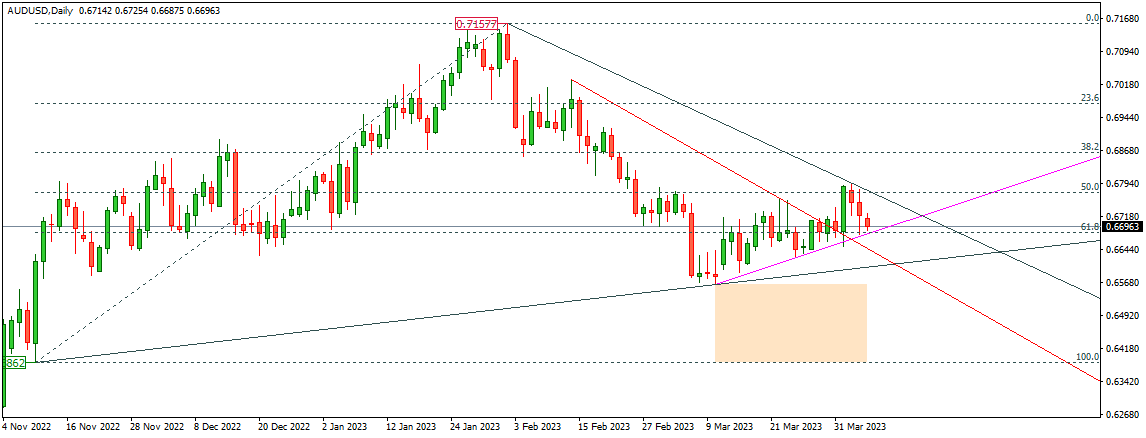

After US House of Representatives Speaker Kevin McCarthy’s comments, China’s Foreign Ministry Spokesperson accused the US of breaking its pledge to Taiwan. The event triggered fluctuations in the value of the Australian dollar. Since Australia is China’s largest trading partner, the Australian Dollar would decline if relations between the two countries deteriorated.
Demand for risky assets has fallen as a result of US-China tensions. Fears of US-China sanctions on the dragon economy have contributed to a further decline in S&P500 futures. US stock markets have closed in the red for two days on fears that the US economy is faltering.
Forecasts call for the US Dollar Index (DXY) to rise beyond 102.00. The weak state of the US labour market could stifle future growth. Demand for US government bonds is rising rapidly as investors seek safety in the possibility that the Fed would pause policy tightening. The yield on the 10-year US Treasury now sits at 3.29 per cent.
On Wednesday, ADP reported fewer job gains in March than in February. In March, the US economy added 145K jobs, lower than the consensus estimate of 200K and the prior reading of 242K. Slower hiring has occurred due to rising Fed interest rates and pessimistic economic forecasts. Recruitment slowed after the Job Openings data was released, indicating that the US labour market is cooling and the Unemployment Rate may climb.
The latest data on employment in the United States, known as Nonfarm Payrolls (NFP), will be released on Good Friday. The average estimate for unemployment is 3.6%. The inflation outlook for US consumers may increase if the average hourly wage rises. We anticipate a decrease in the annual labour cost index from 4.6% to 4.3%. Paychecks can increase by 0.3% every month instead of 0.2%.
Conclusion
Buyers of AUD/USD are encouraged by recent soft US figures and yields.