
In January, producer prices in the United States rose more than expectation. It recorded the largest increase during the last four years. The higher producer prices are related to the increase in the costs of some services and energy products. Amid the increasing energy prices, the good news is that Dollar has continued to get stronger. This helps taming the inflation rate.
This was confirmed by the US Labor Department. The producer index increased by 0.6 percent in January 2017; meanwhile, the increase was 0.2 percent in December 2016. The January rate was the largest increase since September 2016.
How The Increasing Producer Prices Affect The Consumer

The rise in producer prices was attributable to several causes. During January, manufacturers in the United States reported increasing raw material prices. A price index released by the Institute for Supply Management (ISM) reached its highest level since May 2011. According to ISM, the increase has been constant for 11 months. Another reason is the increase of commodity prices. This is especially true for essential commodities such as crude oil. Oil prices increased by more than $50 per barrel.
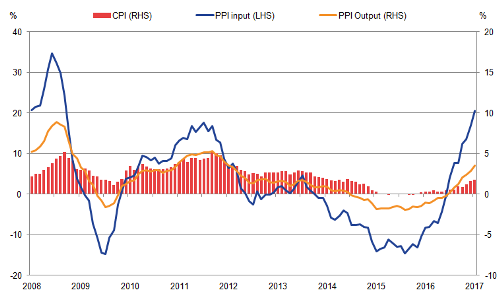
Fortunately, the consumer inflation due to increasing producer prices could be limited by the fact that dollar has kept stronger during the last few months. According to a government reported, which was released last week, import prices decreased in January. On the other hand, wholesale food prices has keep unchanged during January after increasing by 0.5% in December 2016.
Despite insignificant effect upon the consumer inflation, the increasing producer prices have affected the consumers on certain aspects. In January, prices of several final goods hiked by 1.0% after increasing by 0.6% in December 2016. The healthcare costs increased by 0.2%. This certainly affects the index of personal consumption expenditure (PCE).
Energy Prices and the Increasing Producer Prices
As mentioned above, the increasing producer prices are related to the hiking energy prices. In January 2017, average electricity price for residential purposes was 12.3 cents per kilowatt-hour (kWh). It is expected to increase to 12.5 cents per kWh until March 2017. It equals to an average increase by 3.0% in 2017. Below are some facts related to energy prices in 2017:
- In 2016, the total electricity generation of the United States was 11.150 gigawatt hours per day on average. It is expected to decrease by 0.1% in 2017, despite expected growth by 1.5% next year.
- Natural gas prices have been higher, thus causing the decline of electricity generation from natural gas, from 34% in 2016 to 32% in 2017, despite expected hike to 33% next year.
- An increase is seen in the generation share from coal, from 30% last year to 31% in 2017 and 2018.
- Generation share from hydropower remains unchanged in 2017 and 2018.
- Electricity generation from nuclear power is expected to decline in 2017 and 2018.
Combinations of increasing energy prices and raw material prices have contributed to the increase producer prices index. Even though the strengthening dollar keeps the inflation tamed, the consumers are still affected by the surge.