
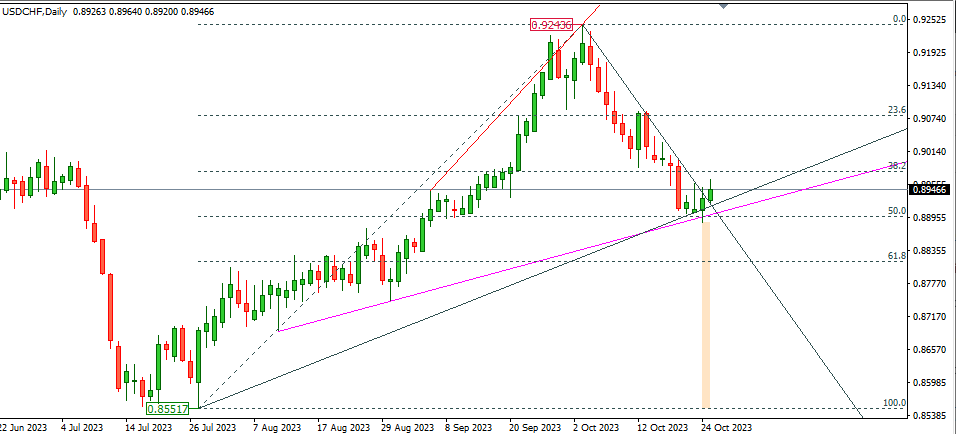
The US dollar strengthened against the Swiss franc again on Wednesday, with prices hovering above 0.8950 in early European trade. The US dollar appreciated because of the PMI data, which showed improvement in the US manufacturing sector.

The Swiss franc might take a hit from the results of that ZEW survey. In October, expectations dropped from 27.6 to 37.8. The decline is a reflection of the weakening Swiss economy and labour market.
After initial support from market risk aversion due to political worries between Israel and Hamas, the Swiss franc has seen its value decline. Investors’ willingness to take risks rises as a result.
The US Dollar Index (DXY) bounced back from the month’s lows and settled around 106.30 on Tuesday after positive preliminary S&P Global PMI numbers were posted.
At press time, the yield on a 10-year US Treasury bond was 4.82%, which might weaken the dollar.
In October, the United States’ S&P Global Composite PMI increased from 50.2 to 51.0. The PMI for the services sector rose to 50.9 from 50.0 the month before. For the first time in over six months, manufacturing has maintained a reading over 50, indicating an improving trend.
Thursday will bring the release of US Q3 GDP, and Friday will get the release of US Core Personal Consumption Expenditures (PCE).
Trade Idea:
Given the USD/CHF’s upward momentum as it approaches 0.8950, a long position on this pair might be advantageous, thanks to robust US PMI data. However, closely monitor the ongoing developments between Israel and Hamas for potential market impact.