
The Bank of Japan (BoJ) is widely expected to avoid ultra-easy monetary policies. Therefore, USD/JPY sellers have returned after a brief hiatus the previous day. However, after bouncing off a rising support line in place for the past three weeks, the Yen pair fell to 145.80 early Thursday morning in Europe.
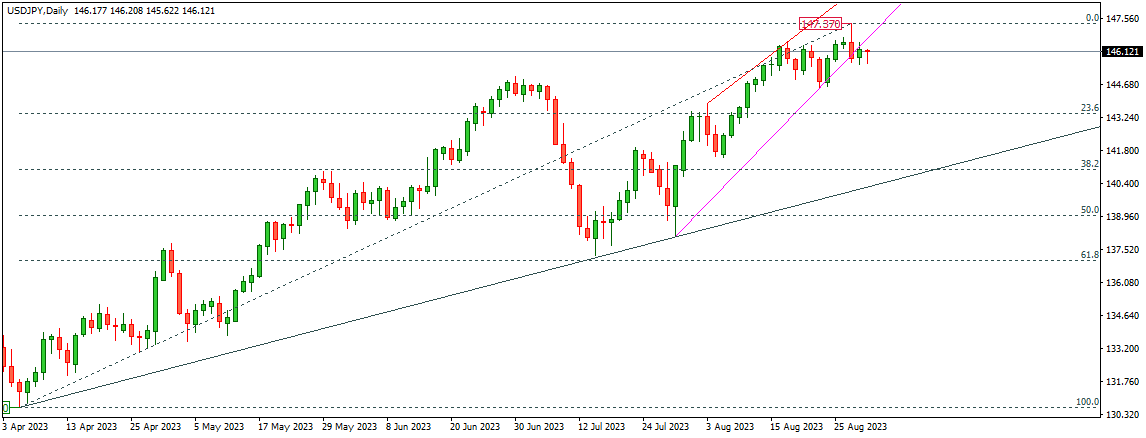

Toyoaki Nakamura, a member of the Bank of Japan’s board of governors, has recently made comments that have fueled hawkish fears about the BoJ and its effect on the USD/JPY exchange rate. While Japan’s economy is no longer under deflation, BoJ Governor Nakamura cautions that “the deflationary mindset is yet to be eradicated.”
The USD/JPY may have been influenced downward by several factors, including hawkish BoJ concerns and inconsistent comments from Japanese government officials regarding the circumstances of industrial production. “Japan government official stated that factory output in August has undershot risk due to global economic downturn,” Reuters reported.
The US Dollar Index (DXY) has fallen for three consecutive days but currently targets the 200-day moving average (DMA) support level near 103.10. Due to uncertainty around imminent US data, S&P 500 Futures cannot replicate Wall Street’s advances. However, yields on 10-year US Treasuries are still near a three-week low of roughly 4.11% as of this writing.
Friday’s NFP surprise also lured USD/JPY bears, as the ADP Employment Change fell to 177K from 195K market expectations and 371K previous readings (increased from 324K). Similarly, the GDP Price Index for the second quarter of 2017 in the United States dipped to 2.0% from 2.2%, while the annualised GDP fell to 2.1% from 2.4%. Also decreasing was the preliminary PCE price index, which went from 2.6% to 2.5%.
Before, dovish central bank calls were supported by data on US consumer confidence and activity as well as the housing market, which led to a decline in the value of the US dollar.
Predicting future USD/JPY exchange rates will require the Fed’s preferred inflation indicator, the August US Core Personal Consumption Expenditure (PCE) Price Index. The August US Core PCE Price Index will be crucial for intraday changes due to concerns over a possible shift in Fed policy. This index is expected to remain unchanged from July at 0.2% MoM but to increase to 4.2% YoY from 4.1%.