
Global investment management firm, VanEck, has recently published a report on Solana. As per VanEck, SOL has a tremendous capacity to touch a four-figure price. Following VanEck’s discovery, the blockchain and cryptocurrency communities have discussed it extensively. By 2030, Solana’s native token SOL will trade between $9.81 and $3,211.28, according to this analysis. A stunning SOL price projection has captivated both new and experienced cryptocurrency investors.
VanEck Report Highlights Solana’s Potential for a Blockchain Game-Changer
To promote Solana as a blockchain and cryptocurrency pioneer, the report must be optimistic. Ethereum is a prominent blockchain standard. From $11,800, Solana may become a big contender in this industry. To reach beyond decentralized enthusiasts, blockchain technology needs a compelling and generally attractive application, according to this research.

The small user base suggests that blockchain technology is not popular. There are 44 million monthly users and 5.5 million daily users of smart contract platforms (SCPs). These estimates may exaggerate the number of blockchain users because many people have several addresses. The statistics are significantly lower than those of Facebook and PayPal, which have billions of daily users.
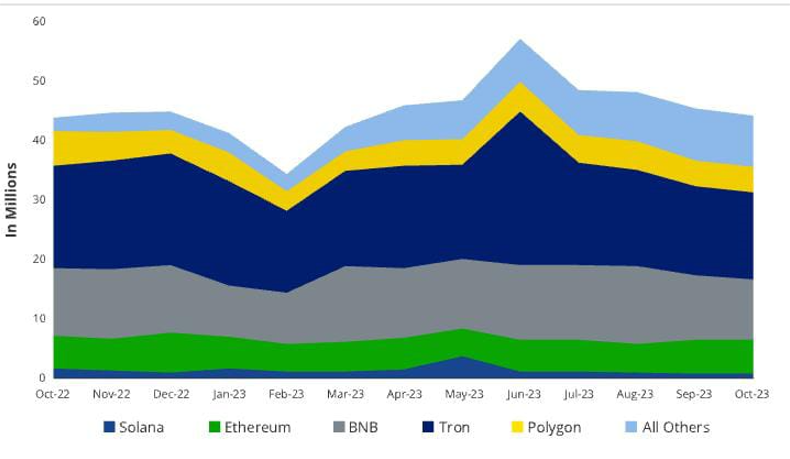
Source: VanEck
Blockchain adoption is delayed because of its complexity and restricted ecosystem activity, mostly value exchange and speculation. Expanding the crypto market requires software that overcomes decentralization and appeals to more people. According to VanEck, Solana could be the first blockchain platform to run a single app with over 100 million users. The app’s popularity is key to Solana’s success and cryptocurrency acceptance.
Studies show Solana’s potential due to the founding team’s focus on scalability and technology. Solana optimizes blockchain efficiency across all components for technological feasibility.
Solana’s Versatile Local Fee Markets Pave the Way for ‘Killer Applications
The data flow capacity helps customers. Transaction processing takes roughly two seconds in Solana. Alternative blockchain systems like Ethereum use a less efficient method that can take minutes to process transactions. Solana’s transaction speed gap could boost usability.
Solana introduced blockchain-optimized Local Fee Markets to improve user experience. Other blockchain ecosystems are less congested because local fee markets allow numerous users to interface with distinct blockchain components. A “killer application,” which demands user involvement, needs local free markets.

Source: VanEck
Solana’s Local Fee Markets, which collect demand-based fees, split pipelines so many apps can coexist and be accessible during high consumption. Solana’s versatility may let developers adjust transaction fees to their economic value, enhancing expenditure estimation.
VanEck concludes that Solana’s blockchain environment is promising. Solana is carefully presenting itself as a champion of mass blockchain usage and the “killer application.” This is achieved by emphasizing accessibility, scalability, and unique features like local fee markets. With 100 million users, Solana could alter blockchain technology.