
EURAUD has been exhibiting bearish momentum on the 4-hour chart after recently rejecting a key horizontal resistance level. The pair has been trading within an uptrend since late February, but current price action suggests a possible reversal or deeper correction might be underway.
The price recently found resistance near the 1.74000 level and has since pulled back to the current 1.71402 level. This rejection occurred after forming what appears to be a double top pattern, which typically signals a trend reversal when confirmed by a break below the neckline support.

Looking at moving averages, the price is currently trading above both the 100 SMA (blue line) and 200 SMA (red line), suggesting that the longer-term bullish bias remains intact despite the recent pullback. However, the recent bearish candles breaking below the 100 SMA could indicate weakening bullish momentum.
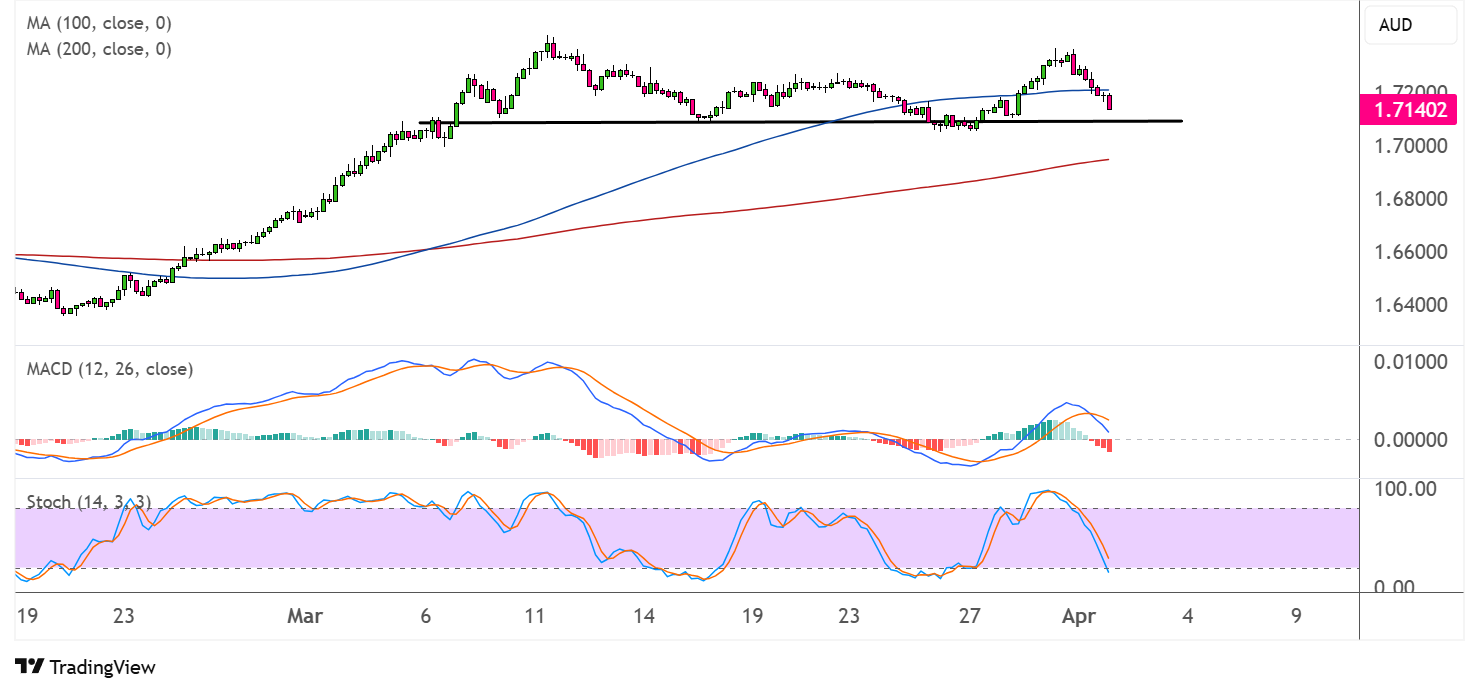
The MACD indicator (12, 26, close) shows a bearish crossover with the blue line crossing below the orange signal line, confirming increasing bearish momentum. The histogram has also shifted into negative territory, reinforcing this bearish view.
The Stochastic oscillator (14, 3, 3) is showing a downward trajectory from the overbought region, suggesting that sellers are gaining control. This indicator’s movement below the 80 level confirms that bearish pressure is building.
Key support levels to watch include the horizontal support zone around 1.70000, which aligns with previous resistance-turned-support. If this level fails to hold, we could see a deeper correction towards the rising 200 SMA near 1.6800.
Earlier this week, the RBA announced its decision to keep interest rates on hold at 4.10% as expected, confirming a shift away from its dovish bias. However, data points from Australia continue to reflect weakness, particularly in employment and inflation, while the trade exposure to China and therefore U.S. tariffs could also pose risks.
Risk sentiment could be a key driver for EURAUD price action moving forward since traders are still waiting on Trump’s tariffs implementation and potential delays.