
EURAUD appears to be staging a recovery after finding strong support around the 1.7229 level, which marks the swing low from its recent downtrend. The pair is currently trading at 1.7376, having bounced significantly from its recent lows.
The descending trendline that has been capping gains since late April remains a key resistance to overcome. Price is now testing the 38.2% Fibonacci retracement level at 1.7384, which could prove to be a pivotal point for the pair’s near-term direction.

If buyers maintain momentum, the next resistance zones are clearly defined at the 50.0% Fib level at 1.7433 and the 61.8% Fib at 1.7481. A successful breach above these levels could pave the way for a test of the 100.0% retracement at 1.7638, where the previous swing high is located.
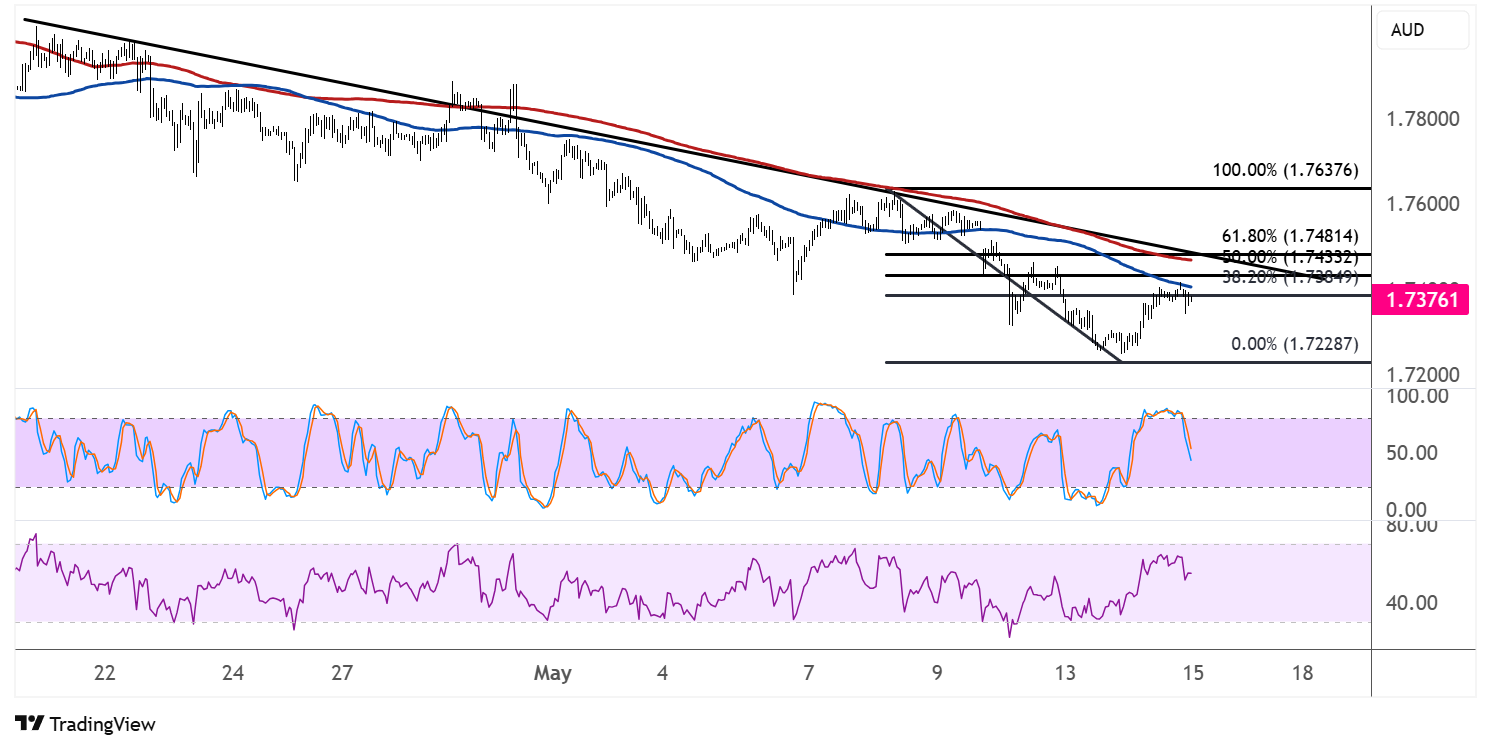
The 100 SMA (blue line) is still below the 200 SMA (red line), suggesting that the path of least resistance remains to the downside. Price is currently testing the 100 SMA, which could continue to hold as dynamic resistance, although a break higher could hit a ceiling at the 200 SMA as well.
Looking at momentum indicators, the stochastic oscillator has recently turned lower from the overbought zone, indicating that bearish pressure could emerge in the short term. Meanwhile, the RSI is hovering in the mid-range around 50, leaving room for movement in either direction, though it appears to be turning lower.
Earlier on, the Australian economy printed stronger than expected quarterly wage growth then upbeat labor market data, reflecting its resilience despite trade war concerns early in the year. The latest trade agreement between the US and China has also proved supportive for the Australian currency, barring further tensions.
Meanwhile, the EU could still be facing pushback in trade discussions with the US, as the prospect of increased tariffs on tech or automobiles could bring more downside for the shared currency.