
GBPCAD remains entrenched in a sideways consolidation pattern, with the pair currently testing the lower boundary of its established trading range around the 1.8350-1.8400 support zone.
The currency pair has been oscillating within this range for several weeks, indicating indecision among market participants.

The horizontal support level at 1.8357 has proven resilient on multiple occasions, providing a solid floor for any corrective declines. This level coincides with previous swing lows and represents a crucial inflection point for the pair’s near-term direction.
A sustained break below this support could trigger a more significant selloff toward the next major support area.
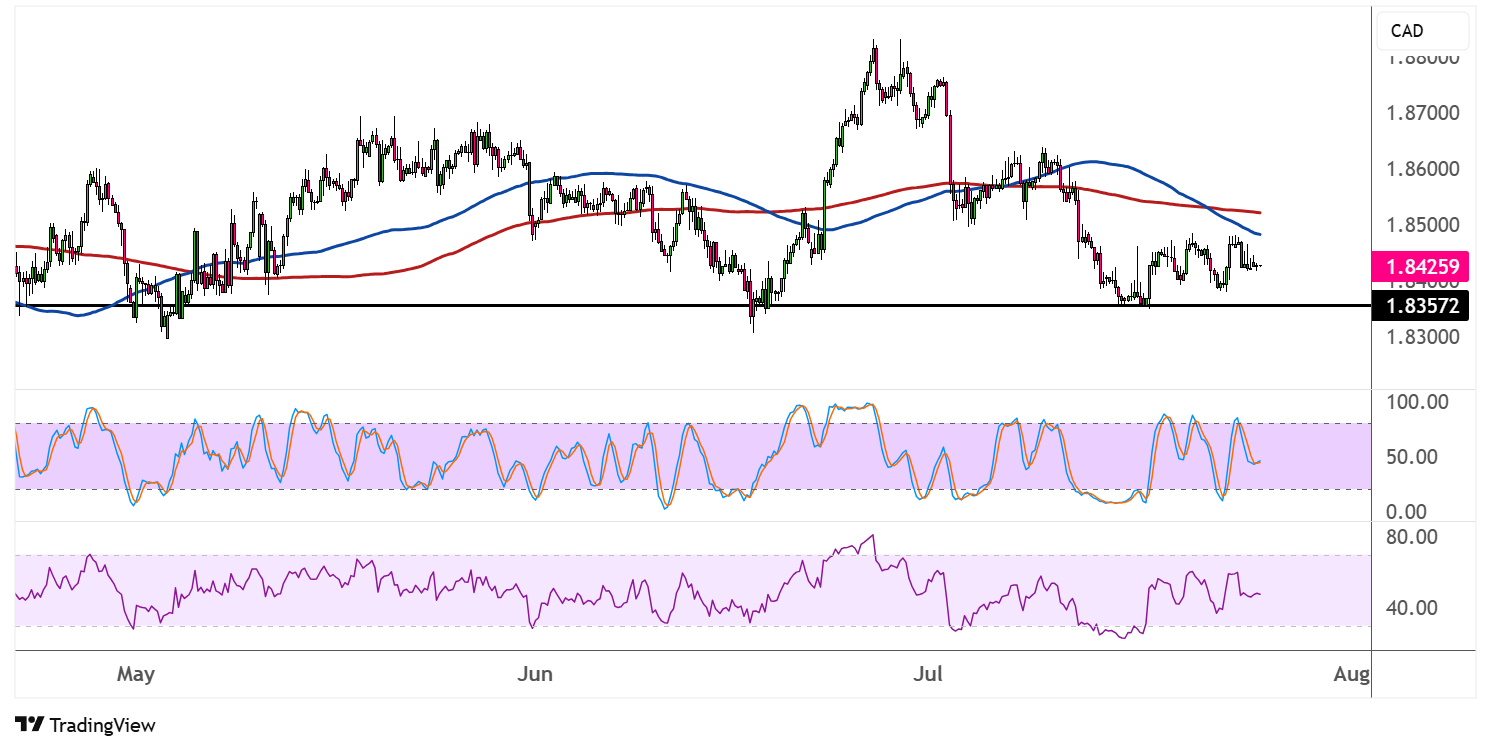
Both the 100 and 200 simple moving averages are converging around the 1.8550-1.8600 zone, creating a dynamic resistance cluster that has capped recent recovery attempts. The moving averages are trading relatively flat, reflecting the sideways nature of the current price action and suggesting that neither bulls nor bears have established clear control.
The range highs around 1.8650-1.8700 continue to act as formidable resistance, with sellers emerging whenever the pair approaches these levels. Any breakout above this ceiling would likely target the next resistance zone around 1.8750, while a breakdown below current support could open the door to a test of 1.8250.
Technical indicators are providing mixed signals, with stochastic oscillators hovering near the middle of their range, indicating neutral momentum. The oscillator has room to move in either direction, suggesting that a decisive breakout could be forthcoming once market sentiment clarifies.
RSI is also trending sideways around the 50 level, reinforcing the lack of directional conviction in the current market environment. The indicator’s neutral positioning suggests that traders are awaiting fresh catalysts to determine the pair’s next significant move.
GBPCAD could continue to take cues from fundamental factors, particularly the monetary policy divergence between the BOE and BOC that could further be highlighted by upcoming data from the UK and Canada.